Drinking Habits · When to Drink
How to Stay Hydrated on Night Shift, From Waking to Daytime Sleep
A drink plan that starts when you wake at 3 PM and ends before you sleep at 9 AM.
 By the Glubbo Editorial Team · Updated Oct 19, 2026 · 8 min read
On This Page
- How Do You Stay Hydrated on a Night Shift?
- How Much Water Should You Drink on a 12-Hour Shift?
- What Is a Good Water Schedule for Night Shift Workers?
- When Should You Stop Drinking Coffee on a Night Shift?
- Drinking Before You Sleep in the Daytime
- Food on a Night Shift Brings Water Too
- Are Energy Drinks a Good Idea on Night Shift?
- What If Your Night Shift Is Hot?
- Days Off and Switching Back to Days
- Set Your Reminders to Your Shift
- Sources
Short answer
Drink on waking, at each break, then stop before sleep.
- On a 12-hour night, about two-thirds of your day's drinks fall inside the shift.
- Keep coffee to the first half: caffeine has a half-life of 5 to 6 hours.
- Stop full drinks about 2 hours before your daytime sleep.
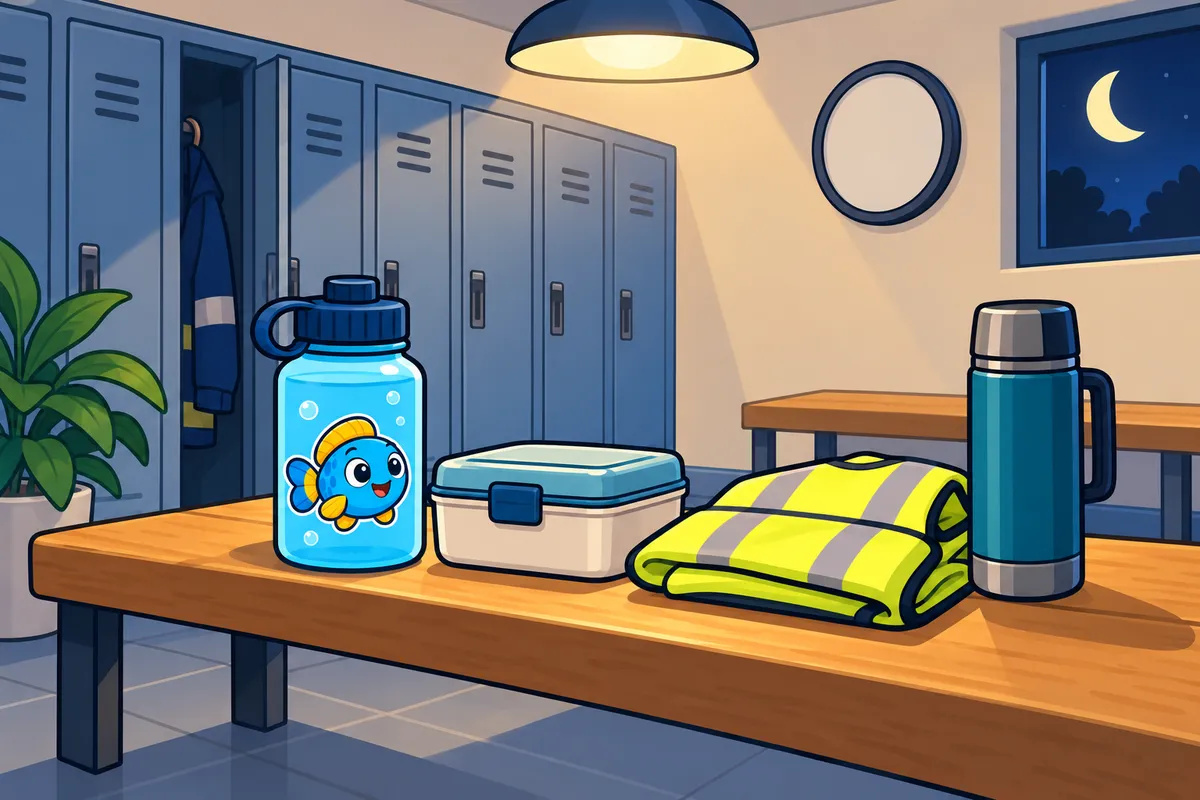
A night shift turns your drinking day upside down. Breakfast comes at 4 PM, lunch at 1 AM, and your bed waits for you after sunrise.
The amount you need stays the same. What changes is where the drinks go: around the shift, its breaks and a sleep that happens in daylight.
How Do You Stay Hydrated on a Night Shift?
Start counting when you wake up, whatever the clock says. Drink a glass on waking, fill a bottle before handover, refill it at your meal break and finish it by the last two hours of the shift. Then stop full drinks about two hours before you sleep, so a full bladder does not cut your daytime sleep short.
One Night, Four Refill Points
- On waking, a 300 ml (10 oz) glass before anything else
- At handover, a full 500 ml (17 oz) bottle beside you
- At the meal break, refill the bottle and finish it by 4 AM
- Two hours before day sleep, sips only
The refills are tied to fixed moments of the shift, so they still happen on the night everything goes wrong. A cue you meet every night, such as handover or the meal break, does the remembering for you.
How Much Water Should You Drink on a 12-Hour Shift?
About two-thirds of your daily drinks, if you are awake around 18 hours and work 12 of them. For a 1,900 ml (64 oz) goal, that is about 1,250 ml during the shift, or two and a half 500 ml bottles. The rest goes into the hours between waking and handover.
The daily amount comes first. The US National Academies found that adequately hydrated women take in about 2.7 L (91 oz) of total water a day and men about 3.7 L (125 oz). About 80 percent of that comes from drinks and the other 20 percent from food.
How Much of Your Water Falls Inside the Shift
Each goal below comes from Glubbo's habit formula: 30 ml per kg, adjusted for activity, climate and sex, rounded to 50 ml. Treat each goal as Glubbo's habit target, and follow your doctor's number if you have one.
| Worker | Glubbo goal | Shift | Awake hours | Drinks inside the shift |
|---|---|---|---|---|
| Gloria, ICU nurse, 58 kg (128 lb), on her feet all night | 1,900 ml (64 oz) | 7 PM to 7 AM | 18 | about 1,250 ml (12 of 18 hours) |
| Farid, warehouse picker, 85 kg (187 lb), lifting all night | 3,000 ml (101 oz) | 10 PM to 8 AM | 16 | about 1,900 ml (10 of 16 hours) |
| Zainab, security guard, 72 kg (159 lb), mostly seated | 1,900 ml (64 oz) | 7 PM to 7 AM | 16 | about 1,425 ml (12 of 16 hours) |
Farid's share is the largest in liters, because his goal is. Zainab's share is the largest as a fraction: 12 of her 16 waking hours happen at work, so three-quarters of her drinks have to fit between handovers.
What a Study of Hospital Shifts Found
Many shift workers start the shift already behind. A study of nurses and doctors on hospital admissions wards, published in Clinical Nutrition, tested their urine at the start and end of 130 shifts.
- 88
- nurses and doctors finished the study
- 36 %
- dehydrated at the start of their shift
- 45 %
- dehydrated at the end of it
The researchers counted a urine concentration above 800 mOsmol/kg as dehydrated. The dehydrated staff also did worse on some short-term memory tests, so the first glass on waking matters as much as the bottle a nurse keeps in the staff room.
Drink More in the First Half of the Night
Front-load the shift. If most of your drinks fall between handover and 3 AM, the last hours bring fewer bathroom trips and your bladder is close to empty when you get home.
A bottle you finish by 4 AM also leaves room for the stop before sleep. Back-loading the night does the opposite: you reach 6 AM behind, drink a liter at once and lie awake at 10 AM needing the toilet.
What Is a Good Water Schedule for Night Shift Workers?
One that runs from your wake time to two hours before your daytime sleep, with each drink tied to a moment of the shift. Here is Gloria's night for her 1,900 ml goal. She wakes at 3 PM, works 7 PM to 7 AM and sleeps at 9 AM.
| Time | Moment | Drink | Running total |
|---|---|---|---|
| 3:00 PM | Wakes up | 300 ml glass of water | 300 ml |
| 4:30 PM | First meal | 250 ml cup of tea | 550 ml |
| 6:30 PM | Before handover | 500 ml bottle, finished by 10 PM | 1,050 ml |
| 12:30 AM | Meal break | 250 ml glass with her meal | 1,300 ml |
| 1:00 AM | Back on the ward | Bottle refilled, finished by 4 AM | 1,800 ml |
| 6:00 AM | Last round | 100 ml of sips | 1,900 ml |
Her last full drink ends at 4 AM, five hours before she sleeps. A few sips at 6 AM and with breakfast at home do not count against the stop.

To build your own list, enter your wake time and your morning bedtime in the drink-time planner. It lays the drinks across midnight and puts the last one an hour before you sleep; enter a bedtime an hour earlier if you want two hours. Day workers can compare it with the refill points of a desk job, which follow the same idea on a 9-to-5 clock.
When Should You Stop Drinking Coffee on a Night Shift?
In the first half of the shift. NIOSH, the US institute for workplace safety, says caffeine has a half-life of 5 to 6 hours and can stay in your system much longer. A coffee near the end of a night shift can still wake you or make you restless once you try to sleep, its training for nurses warns.
Caffeine takes about 30 minutes to work, with a range of 15 to 45 minutes. So a cup before the hardest stretch, such as 1 AM, helps more than one at 6 AM. The same course, in its diet advice for night work, asks you to "try to have only light caffeine during your shift".
Coffee at 1 AM
- Works by about 1:30 AM, before the slow hours
- Half has cleared by 6 or 7 AM
- Less than half left by a 9 AM sleep
Coffee at 6 AM
- Works as the shift ends
- Half still in you at 11 AM or noon
- Lands in the middle of your sleep
The coffee still counts toward your goal, because a normal mug's caffeine does not cancel out its water.
Drinking Before You Sleep in the Daytime
Have a small drink with a small breakfast, then stop. NIOSH tells night workers to eat a small breakfast before day sleep so hunger does not wake them, and to avoid large meals in the 1 to 2 hours before the main sleep.
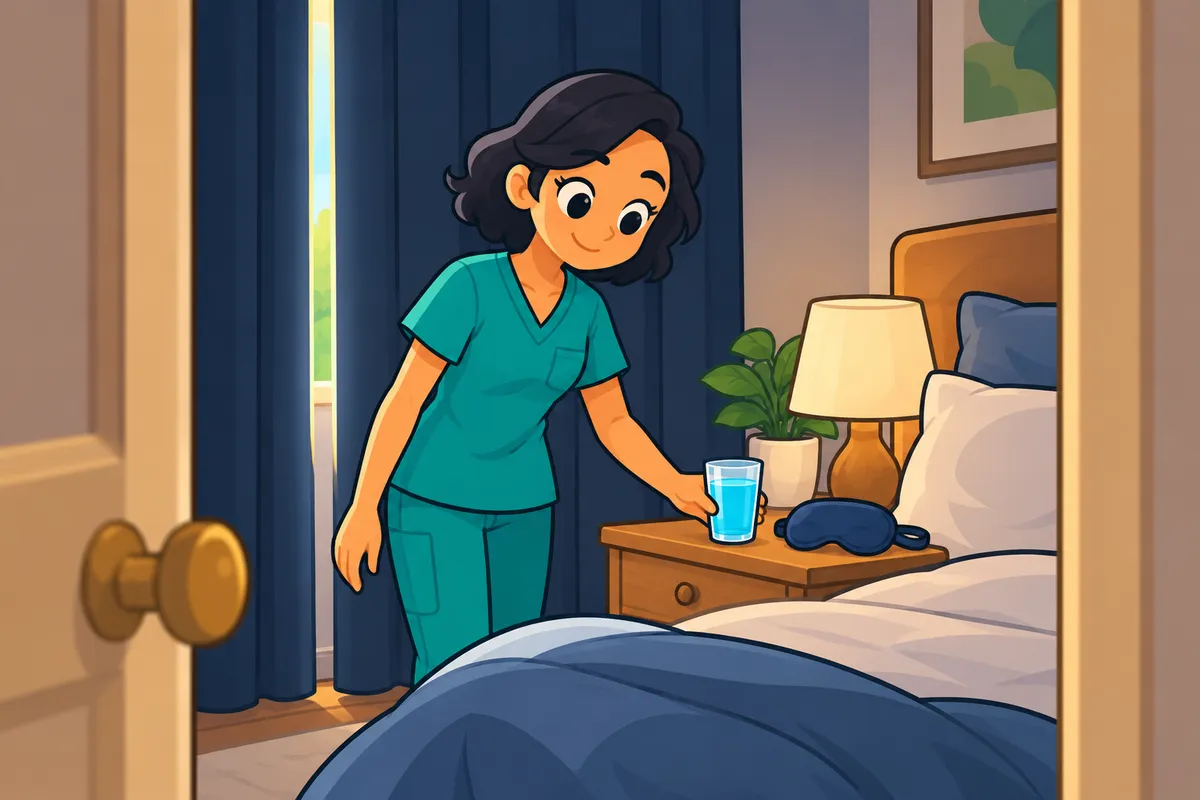
The same timing works for drinks. If you wake from daytime sleep to pee, move your last full drink to two hours before bed and add it to the first half of the night instead. If you sleep through, a glass an hour before bed is fine, and the full reasoning for the two-hour gap applies to a 9 AM bedtime as much as to 11 PM.
Food on a Night Shift Brings Water Too
What you eat at 1 AM adds to your fluids. About a fifth of your water comes from food, and the NIOSH list of foods for the shift is full of water.
Foods NIOSH suggests for the night shift
7 items- Vegetables and salads
- Vegetable soups
- Fruit
- Yogurt
- Wholegrain sandwiches and cheese
- Eggs and nuts
- Green tea
The NIOSH diet page also asks you to:
- avoid eating, or eat less, between midnight and 6 AM;
- skip sugar-rich foods that can make you sleepy.
A soup or a bowl of fruit at the meal break does both jobs, and cucumber, lettuce and melon top the list of watery foods.
Are Energy Drinks a Good Idea on Night Shift?
NIOSH's advice for night work is to "try to have only light caffeine during your shift", and an energy drink is a way to get a lot of caffeine in one can. If you drink one, treat it as your coffee for the night and keep it in the first half of the shift, because the 5-to-6-hour half-life applies to it too. How much caffeine the cans carry, and whether they count as water, is on its own page.
What If Your Night Shift Is Hot?
A warehouse or kitchen at night can run hot, and then the heat pace takes over from the shift share. NIOSH advises:
- about 1 cup (8 oz) every 15 to 20 minutes for moderate work in the heat;
- no more than 6 cups an hour.
At that pace a hot 12-hour night can ask for far more than the 1,900 to 3,000 ml in the table, and sports drinks with electrolytes matter once sweating runs for hours.
Days Off and Switching Back to Days
Your goal does not change on a day off. Only the clock does: on your first day back on a day schedule, count from your new wake time and use the usual cues:
- a glass on waking;
- a drink with each meal.
The switch day is where most people come up short. You sleep in the morning, wake at noon and the day is half gone, so drink your first 500 ml in the first hour to catch up.
Set Your Reminders to Your Shift
Reminders set for daytime hours go off while you sleep and stay silent at 3 AM. Move them: set your wake time to the afternoon and your bedtime to the morning, and put quiet hours over your daytime sleep. Some apps start with a daytime window, and a night shift gets no reminders until you move it.
Set up your phone before the first night
- Set your wake time to the afternoon and your bedtime to the morning
- Put quiet hours over your daytime sleep
- Check that the shift's Focus mode lets the water reminders through; on an iPhone a Focus holds a water app's reminders until it ends
- No app? An alarm on your phone or watch can follow the same times
In the Glubbo app, the Strict style reminds at every interval until you reach your goal, which suits a night with no natural breaks.
General information for healthy adults, not medical advice. If a doctor has set your fluid amount, follow that.
More in Drinking Habits


Sources
- CDC, National Institute for Occupational Safety and Health. NIOSH Training for Nurses on Shift Work and Long Work Hours, Module 6: Caffeine, 2015.
- CDC, National Institute for Occupational Safety and Health. NIOSH Training for Nurses on Shift Work and Long Work Hours, Module 9: Diet Suggestions for Night-Shift Nurses, 2015.
- CDC, National Institute for Occupational Safety and Health. NIOSH Training for Nurses on Shift Work and Long Work Hours, Module 9: Diet Suggestions (Continued), 2015.
- Clinical Nutrition (El-Sharkawy and colleagues). Hydration amongst nurses and doctors on-call (the HANDS on prospective cohort study), 2016.
- National Academies of Sciences. Report sets dietary intake levels for water, salt, and potassium (press release), 2004.
Sources checked by the Glubbo Editorial Team on Oct 19, 2026. General information, not medical advice. How we write and check our guides.

