Drinking Habits · Building the Habit
How to Stay Hydrated as a Nurse When You Cannot Drink on the Ward
Why your bottle stays off the ward, what three studies of hospital staff found, and a drink plan built on breaks.
 By the Glubbo Editorial Team · Updated Oct 19, 2026 · 10 min read
On This Page
- How Do Nurses Stay Hydrated on a 12-Hour Shift?
- Where Can Nurses Drink Water on Shift?
- How Common Is Dehydration Among Nurses?
- How Much Should You Drink Before a Shift?
- What Does Dehydration Feel Like in the Middle of a Shift?
- How Do You Stay Hydrated Wearing PPE?
- Should Nurses Drink Less to Avoid Bathroom Trips?
- What Counts as a Drink on the Ward?
- What If the Ward Skips Your Breaks?
- Refill Moments That Fit Each Shift
- Common Questions
- Sources
Short answer
Drink before your shift and at every break, off the ward.
- OSHA bans drinking where blood exposure is likely; keep your bottle in the staff room.
- ED nurses in one study drank only 3 to 4 cups in the first 8 hours of a 12-hour shift.
- Tie a refill to each break so the drinks happen on the worst shift too.
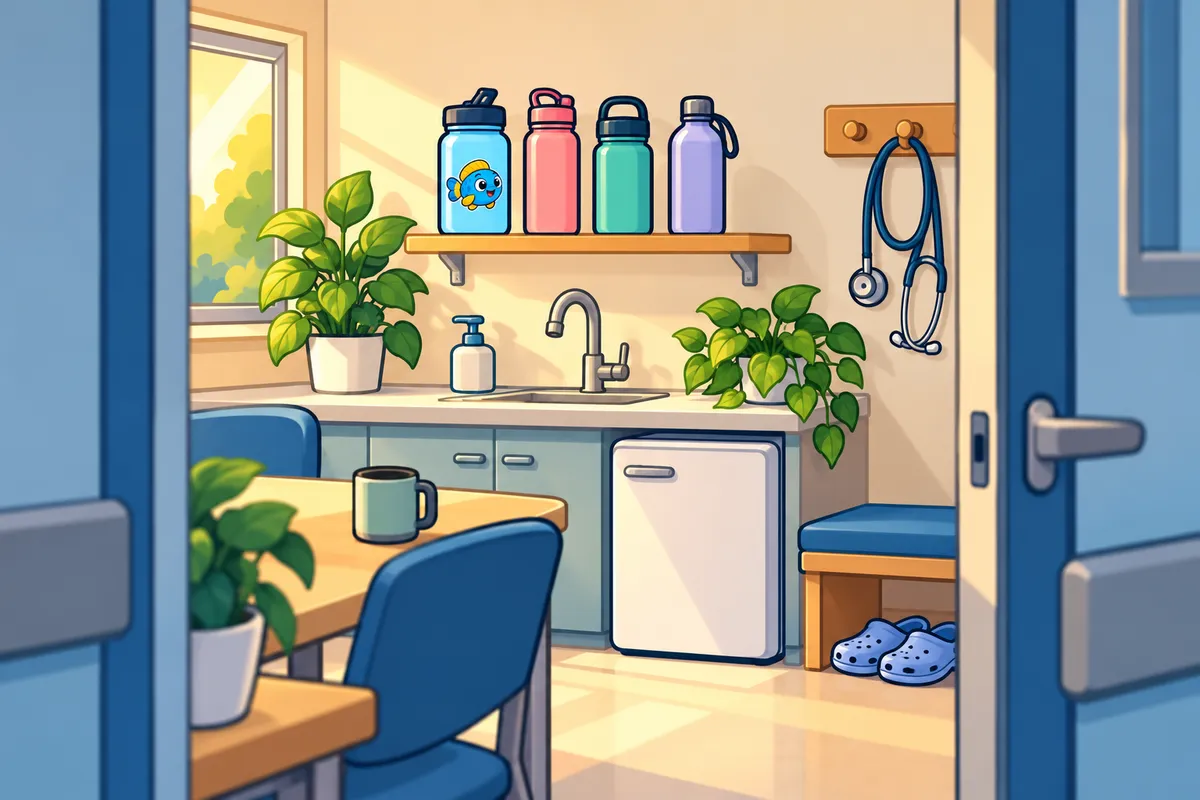
Drink at the moments you are off the floor: a full bottle before handover, a refill at every break, and a drink on the way home. You start at 7, the ward is full by 7:15, and the next time you think about water it is 1 PM and your bottle is still in your locker, where it has to be. The studies below show how common that is.
How Do Nurses Stay Hydrated on a 12-Hour Shift?
By drinking at fixed moments off the ward:
- a full bottle before handover
- a refill at every break
- a drink on the way home
In a study of emergency department staff, nurses and doctors drank only 3 to 4 cups in the first 8 hours of their shift, so most nurses start the plan from behind.
Two nurses on 12-hour day shifts show the arithmetic. Each goal comes from Glubbo's habit formula: 30 ml per kg of body weight, adjusted for activity, climate and sex and rounded to 50 ml. These goals are Glubbo's habit targets, so swap in your doctor's number if you have one.
| Nurse | Glubbo goal | Shift | Awake | Drinks inside the shift |
|---|---|---|---|---|
| Thandi, ward nurse, 70 kg (154 lb), on her feet all day | 2,250 ml (76 oz) | 7:00 to 19:30 | 5:30 to 22:30, 17 h | about 1,650 ml (12½ of 17 hours) |
| ED nurse, 85 kg (187 lb), lifting and running | 3,000 ml (101 oz) | 7:00 to 19:30 | 5:45 to 23:00, 17¼ h | about 2,170 ml (12½ of 17¼ hours) |
Thandi's arithmetic: 70 × 30 = 2,100 ml, plus 300 for a very active day, minus 150 for a woman, gives 2,250 ml. The ED nurse's is 85 × 30 = 2,550, plus 300 and plus 150, which makes 3,000 ml.
Thandi's bottle size decides how many fills her shift needs, and the ED nurse's goal needs more:
| Bottle | Thandi (~1,650 ml a shift) | ED nurse (~2,170 ml a shift) |
|---|---|---|
| 500 ml (17 oz) | 3.3 fills | 4.3 fills |
| 750 ml (25 oz) | 2.2 fills | 2.9 fills |
| 1,000 ml (34 oz) | 1.65 fills | 2.2 fills |
Not every ward gives three breaks. In the emergency department study, nurses had a 1-hour break per 12-hour shift, and the doctors had none. If your breaks are short, split them: two minutes in the staff room every time you pass it counts more than one long drink you never get to.
Where Can Nurses Drink Water on Shift?
In the staff room, because federal law bans drinking wherever you might meet blood. The OSHA bloodborne pathogens standard says eating and drinking "are prohibited in work areas where there is a reasonable likelihood of occupational exposure," and it keeps food and drink off counters and out of fridges where blood or other infectious materials are present.
Keep Your Bottle Here
- The staff room or break room
- Your locker or a staff-only shelf away from patient care
- The car, for the drive in and home
Not Here
- Patient rooms and bays
- Counters where staff handle specimens or blood
- The fridge that holds specimens or medicines
That is why the rule feels stricter on some wards than others. A post on the American Nurses Association's Healthy Nurse, Healthy Nation site notes that many hospitals stop nurses carrying a water bottle in patient care areas so the bottle does not pick up germs.
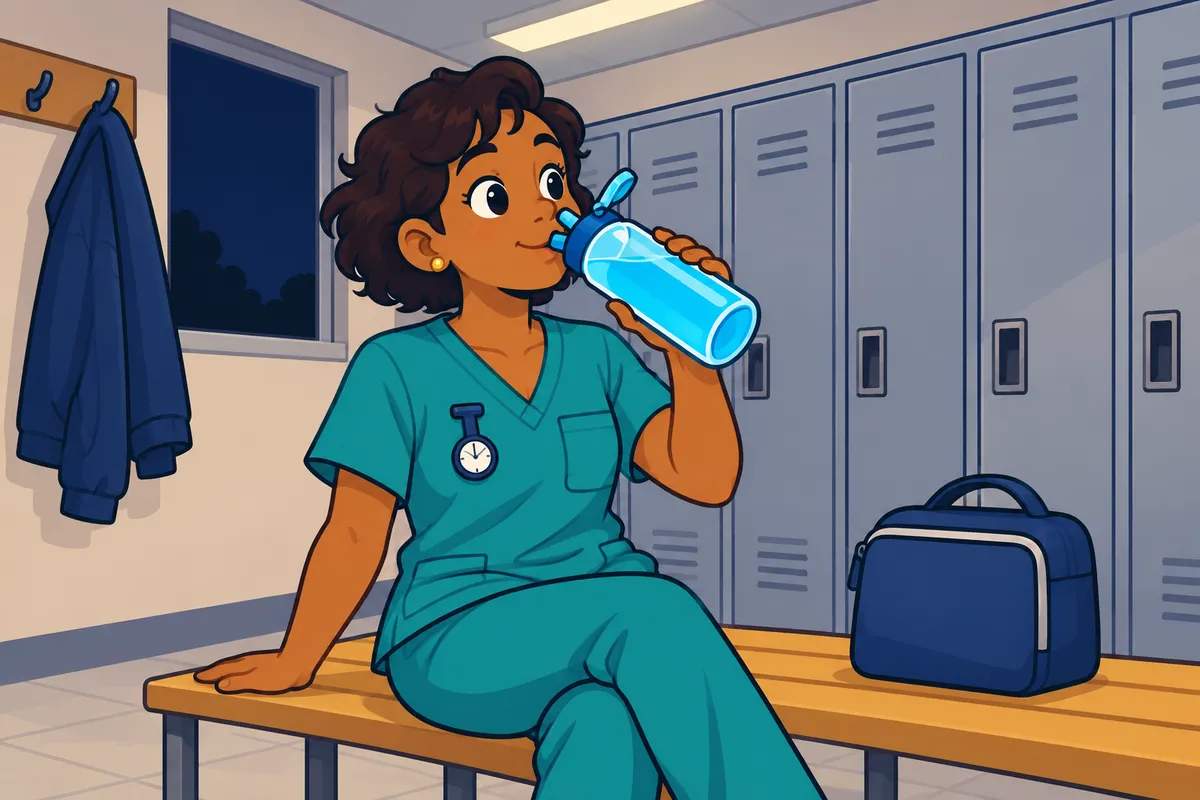
Ask your unit where staff may keep drinks; most have a spot, and few nurses use it as often as they could. The emergency department authors wrote that staff "cannot keep it handy for infection control purposes," which is exactly why the spot needs to be close.
How Common Is Dehydration Among Nurses?
Common enough to show up in every study that has looked. Hospital staff often finish shifts with concentrated urine, and in a 2026 review, 9 of the 15 studies (60 %) linked dehydration during shifts to weaker physical performance.
- 3–4
- cups drunk in 8 hours by ED nurses and doctors
- 41 %
- of ward staff passed very little urine by the end of a shift
- 9 of 15
- studies in a 2026 review tied dehydration to weaker physical performance
The Emergency Department Study
Alomar and colleagues followed 43 nurses and doctors over 172 shifts in a tertiary emergency department. Doctors lost 0.57 kg of body weight by the end of an 8-hour shift; nurses, tested 8 hours into their 12-hour shift, lost 0.12 kg.
The nurses drank more and visited the toilet more often than the doctors, and their urine was less concentrated, with a specific gravity of 1.020 against 1.025. The study read this as better hydration in nurses, but both groups averaged only 3 to 4 cups in 8 hours.
The Ward Study
On medical and surgical admissions wards, El-Sharkawy and colleagues found that 41 % of nurses and doctors were passing too little urine by the end of a shift, below 0.5 ml per kg per hour. More of them ended the shift dehydrated than started it that way, the pattern covered in the plan for nurses on nights.
The 2026 Review
Da'ar and colleagues pulled together 15 studies of healthcare workers.
The review found:
- About 60 % of those studies reported weaker physical performance when staff were dehydrated.
- 53 %, roughly 8 of the 15, documented declines in thinking and mood.
Those are shares of studies, not of workers.
The strain grew with longer shifts, especially for nurses on 12-hour shifts. The authors also call the evidence thin: few studies have looked at healthcare workers, and none yet tests a way to help them drink more. In the ward study, dehydrated staff also scored worse on two short-term memory tests, a lab measure, but the kind of thing that matters when you are holding six patients' numbers in your head.
How Much Should You Drink Before a Shift?
About a third of your day's goal, because the shift will not give it back. In the ward study, 36 % of staff were already dehydrated when the shift started, so the first drinks of the day decide where you begin.
A third of each goal:
- For a 2,250 ml goal, a third is 750 ml: Thandi's 400 ml at breakfast and 500 ml in the staff room come to 900 ml, a little over.
- For the ED nurse's 3,000 ml, a third is 1,000 ml: 500 ml at home and a 500 ml bottle before handover.
Split it in two, one drink at home and one in the staff room, rather than one big drink at the door.
What Does Dehydration Feel Like in the Middle of a Shift?
The NHS lists eight signs in adults, and several of them look like a long shift anyway.
Signs of dehydration in adults
5 items- Feeling thirsty
- Headache and feeling light-headed or dizzy
- Dark yellow, strong-smelling pee, or peeing less often than usual
- Feeling tired
- A dry mouth, lips and tongue, or sunken eyes
Tiredness and a headache at 3 PM are easy to blame on the shift. If they come with dark pee, a drink and a toilet stop at your next break will tell you which it was.
How Do You Stay Hydrated Wearing PPE?
Drink a full bottle before you put the gear on and another as soon as you take it off, because you cannot drink in between.
Heat under gear is the reason to take it seriously: NIOSH advises about 1 cup (8 oz) of water every 15 to 20 minutes for moderate work in the heat, a pace you cannot keep when you cannot drink at all, and it adds sports drinks with electrolytes if the sweating lasts several hours.
In a survey of 105 staff in full PPE on COVID-19 wards, fewer than half managed 500 to 1,000 ml of fluid per shift, and most complained of severe heat.
The same survey found 62 % could only eat after duty, which could mean up to 12 hours under strict contamination procedures. A few staff came close to collapse.
Before and after a stretch in full PPE
- Finish a 500 ml bottle in the staff room before you put the gear on
- Eat a real meal before a long stretch, since you may not eat again until after duty
- Drink straight after each time you take the gear off, once your hands are clean
- Tell the charge nurse early if the heat leaves you dizzy
Hot gear and no drinks is the combination that leaves staff close to collapse, so the drink before you put it on matters most.
Should Nurses Drink Less to Avoid Bathroom Trips?
No; drink, and plan the toilet trips with the drinks. The emergency department authors noted that people, women especially, "will purposefully not drink fluids when bathroom facilities are not available."
Holding back is a poor trade. In the emergency study, the nurses visited the toilet more often than the doctors and also drank more and lost less weight. OSHA's 1998 memo on toilet access links holding urine with more urinary tract infections, and bladder infections are the kind of trouble a bigger daily drink helps keep away.
Pair each drink with a toilet stop instead. A refill at the 10:00 break and a toilet trip at the same break means you are never on the floor with a full bladder and no relief in sight.

What Counts as a Drink on the Ward?
Anything you can finish in the staff room. The NHS counts water, lower-fat milk, tea and coffee toward your daily fluids, so the tea you make at the break is part of the plan, and it asks you to keep juice and smoothies to one small 150 ml glass a day. On nights, keep the caffeinated cup to the first half of the shift.
What If the Ward Skips Your Breaks?
Drink more at each end of the day to make up for the missing middle. On a day with a single break, Thandi can still reach most of her 2,250 ml:
- 900 ml before handover (400 ml at breakfast and a 500 ml bottle)
- 500 ml at the one break
- 500 ml at the end of the shift
- 350 ml on the way home and at dinner
That is 2,250 ml with only one drink during the shift.
The two-hour timer from the nursing post helps on days like this: each alarm is a prompt to take a few sips if you pass the staff room, and a reminder to take a bigger drink at the next break.
Refill Moments That Fit Each Shift
The Healthy Nurse, Healthy Nation post suggests a two-hour timer and a few sips in the break room each time it goes off. Match the refill moments to the shift you work, then set them up tonight; if a phone timer is the part you keep missing, the time you set matters more than the app.
Your shift, your refill moments
- A 12-hour day with three breaksBefore handover, at each break, before you leave
- One long break and nothing elseTwo-minute staff-room stops every time you pass
- Long stretches in full PPEA full bottle before you put it on, another after
- Night shiftsFront-load the night and stop before day sleep
Set up tomorrow's shift tonight
- Ask the charge nurse where staff may keep drinks on your unit
- Pack a large bottle with a lid and a straw for the staff room
- Set a two-hour timer as a nudge for the days without breaks
- Check your urine color at the midday break and drink more if it is dark
If you work a mix of days and nights, keep the same refill moments and slide the clock; your total for the day still comes from the habits that apply on any schedule.
Common Questions
Can nurses drink at the nurses' station?
Only where the employer allows it. OSHA has no general ban on drinks at hospital nursing stations, but the employer must forbid drinking in any area where a drink could be contaminated, and a lid does not change that.
Are nurses legally entitled to breaks?
Not under US federal law, which requires no lunch or coffee breaks, the Department of Labor says. Some states, such as California and Oregon, make private employers give a paid 10-minute rest for every 4 hours worked.
General information for healthy adults, not medical advice. If a doctor has set your fluid amount, follow that.

More in Drinking Habits


Sources
- US Occupational Safety and Health Administration. 29 CFR 1910.1030, Bloodborne pathogens, 2026.
- International Journal of Emergency Medicine (Alomar MZ et al.). Decreased hydration status of emergency department physicians and nurses by the end of their shift, 2013.
- Clinical Nutrition (El-Sharkawy AM et al.). Hydration amongst nurses and doctors on-call (the HANDS on prospective cohort study), 2016.
- Clinical Nutrition ESPEN (Mustofa ND). Hydration and nutrition concerns among healthcare workers on full personal protective equipment (PPE) in Covid-19 wards, 2020.
- Frontiers in Health Services (Da'ar OB, Alhabeeb R, Kalmey F). Healthcare workers hydration status and performance: a scoping review, 2026.
- CDC NIOSH. Workplace Recommendations, 2026.
- NHS. Dehydration, 2026.
- NHS. Water, drinks and hydration, 2023.
- OSHA. Interpretation of 29 CFR 1910.141(c)(1)(i), toilet facilities, 1998.
- Healthy Nurse, Healthy Nation (American Nurses Association), Nurse Alice Benjamin. Stay Hydrated On The Job, 2017.
- US Occupational Safety and Health Administration. Requirements for covered beverages at nurses' stations (standard interpretation), 2006.
- US Department of Labor. Breaks and Meal Periods, 2026.
- US Department of Labor, Wage and Hour Division. Minimum Paid Rest Period Requirements Under State Law for Adult Employees in Private Sector, 2023.
Sources checked by the Glubbo Editorial Team on Oct 19, 2026. General information, not medical advice. How we write and check our guides.

