Water Bottles · Materials and Safety
Stainless Steel vs Plastic Water Bottle: Which Should You Carry?
Weight per ounce held, what lab tests found in each material, and when glass beats both or loses to them.
 By the Glubbo Editorial Team · Updated Nov 2, 2026 · 11 min read
On This Page
- How Do Steel, Plastic and Glass Bottles Compare?
- How Much Heavier Is a Steel Bottle Than Plastic?
- Which Is Healthier, a Stainless Steel or Plastic Water Bottle?
- Does a Stainless Steel Bottle Make Water Taste Like Metal?
- Is Glass Better Than Plastic for a Water Bottle?
- Is Glass or Stainless Steel Better for a Water Bottle?
- Which Reusable Bottle Material Is Better for the Environment?
- Choose the Material for the Way You Drink
- Common Questions
- Sources
Short answer
Steel for cold water and fewer unknowns; plastic for weight.
- Per 32 oz held, Tritan weighs 6.3 oz empty, plain steel 10 oz, glass 26.8 oz.
- Tritan and uncoated steel released no detectable BPA in a 2011 lab test.
- Reusable plastic sports bottles released over 400 plastic compounds in a 2022 study.
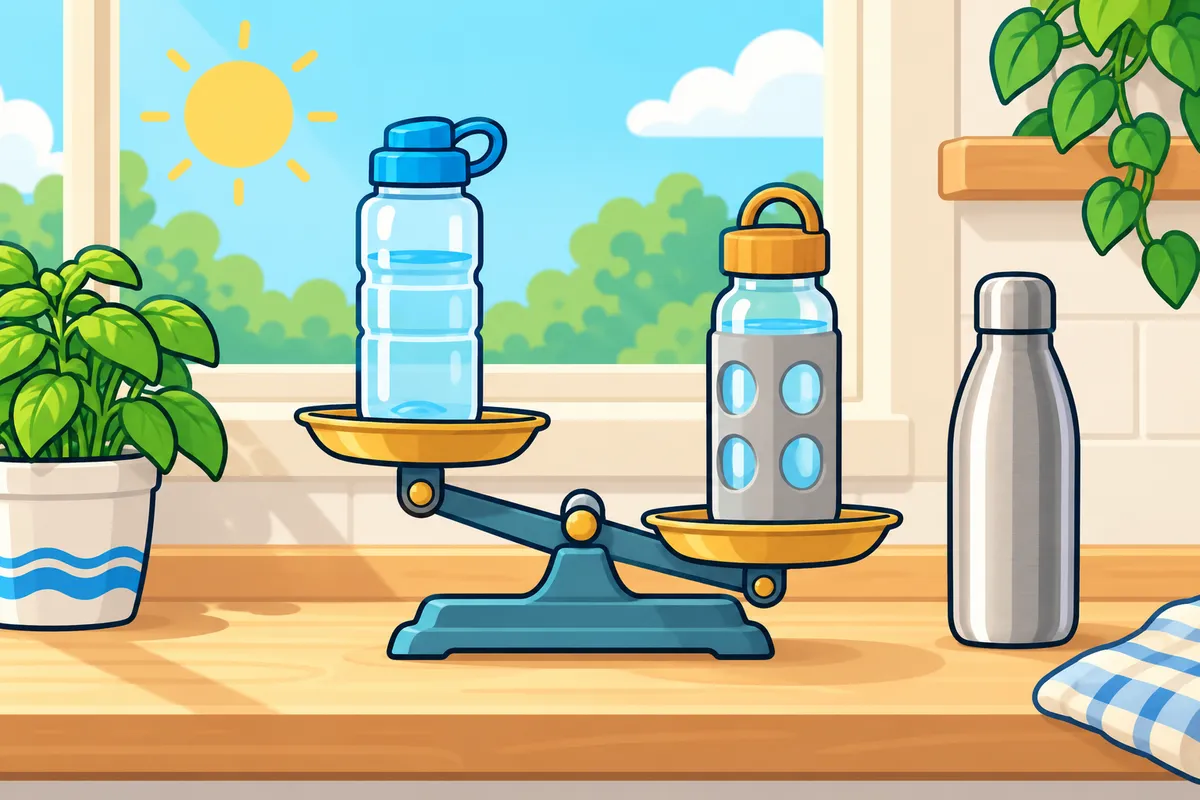
- Pick stainless steel if you want cold water for hours and the fewest open questions about what gets into it.
- Pick plastic if every ounce in your bag counts.
- Glass gives the plainest taste but weighs the most for what it holds, more than four times a Tritan bottle of the same size.
All three are sold for drinking water. The choice comes down to four things you can measure: weight, how long the water stays cold, whether the bottle breaks, and what moves from the bottle into the water.
How Do Steel, Plastic and Glass Bottles Compare?
Plastic wins on weight, insulated steel on temperature, and glass on keeping plastic out of the water, apart from the cap. Four real bottles, with figures from their makers' spec pages, show the trade in numbers.
| Tritan plastic | Plain steel | Insulated steel | Glass | |
|---|---|---|---|---|
| Bottle | Nalgene 32oz Wide Mouth | Klean Kanteen Classic 27oz | Klean Kanteen Insulated Classic 20oz | Lifefactory 22oz |
| Holds | 32 oz (946 ml) | 27 oz (800 ml) | 20 oz (592 ml) | 22 oz (650 ml) |
| Empty weight | 6.25 oz (177 g) | 8.4 oz (238 g) | 12.3 oz (349 g) | 1.15 lb (522 g) |
| Keeps a drink cold | No insulation | No insulation | Iced for 63 hours, hot for 24 | No insulation |
| Dishwasher | Yes | Yes | Yes | Yes, sleeve left on |
| Maker's chemical claim | BPA/BPS-free | BPA-, BPS-, BPF- and lead-free | BPA-free and lead-free | BPA-free |
| Weak point | Warms with the air | Warms with the air | Weight | Weight, can break |
The hours are the maker's claim for its own bottle. The milliliters for the Nalgene come from the NIST factor of 29.57 ml per fluid ounce.
How Much Heavier Is a Steel Bottle Than Plastic?
About 60 % heavier for plain steel, and about three times heavier for insulated steel, measured per ounce the bottle holds. Glass is more than four times the plastic.
Bottles come in different sizes, so compare them per 32 oz of water held. The arithmetic for the glass bottle runs like this: 1.15 lb is 18.4 oz of bottle for 22 oz of water, and 18.4 ÷ 22 × 32 gives 26.8 oz.
What It Means on a Two-Bottle Day
Say you carry 64 oz (about 1.9 L) of water to work or on a day hike. The water alone weighs about 66.7 oz, roughly 4.2 lb.
The bottles add this on top of the water:
- In Tritan, 12.5 oz, about a fifth more.
- In insulated steel, about 39 oz.
- In glass, about 54 oz, so the glass version puts 80 % of the water's weight back on your shoulders as bottle.
That gap shrinks when you refill from a tap during the day, because one bottle filled three times weighs no more than one bottle.

Which Is Healthier, a Stainless Steel or Plastic Water Bottle?
The studies below measured what moves from a bottle into water. None of them followed people to see who got sick, so they cannot say that either material harms or protects a healthy adult.
In the tests:
- Uncoated stainless steel released no detectable BPA, and the authors of the metal test called steel bottles harmless for trace metals in plain water.
- Reusable plastic bottles released more than 400 compounds into water, and that study did not test their health effects.
Steel therefore leaves fewer unknowns in the water.
The research is thin, and most of it tests one material at a time. Each of these four lab studies tested bottles of the kind sold when it was run, so a bottle bought today may differ:
| Study | Bottles tested | What it measured | What it found |
|---|---|---|---|
| Cooper and colleagues, 2011 | Polycarbonate, Tritan, uncoated steel, lined aluminum | BPA moving into water, at room temperature and with boiling water | BPA from polycarbonate and epoxy-lined aluminum; none detected from Tritan or uncoated steel |
| Krachler and Shotyk, 2009 | Stainless steel, coated aluminum, a pewter pocket flask | Trace metals in very pure water after 13 days | Steel and coated aluminum harmless; the pewter flask passed guideline limits for antimony and thallium |
| Tisler and Christensen, 2022 | Reusable plastic sports bottles, new, used and dishwashed | Every compound that reached water in 24 hours | More than 400 plastic-related compounds; dishwashing raised the amounts |
| Kubicova and colleagues, 2023 | Tritan bottles | Oligomers, the short chains that make up a plastic | Under 25 µg per kg by the third test fill in most tests, including a 70 °C (158 °F) hot fill with 20 % ethanol; 170 µg per kg in 50 % ethanol at 70 °C |
BPA, the One Chemical Tested in Both
BPA is the one chemical a single study measured in steel and plastic side by side. The Cincinnati team found:
- BPA coming from polycarbonate and epoxy-lined aluminum, and boiling water raised the amount from the lined ones.
- None from Tritan and uncoated steel.
The FDA calls BPA "a structural component in polycarbonate beverage bottles" and says it "is safe at the current levels occurring in foods". For a bottle bought today, BPA rarely separates steel from plastic; an older clear bottle with a 7 in its recycling triangle is the case where it still can.
What Else Comes Out of Reusable Plastic
BPA is one chemical among many. The Copenhagen study screened water from reusable sports bottles and found more than 400 plastic-related compounds.
Most from used bottles were plasticizers, antioxidants and photoinitiators, and the authors flag photoinitiators for possible hormone effects. Two more findings:
- A dishwasher cycle raised the leaching, and extra flushing with water only halved it.
- The study named the compounds; it did not test whether the amounts harm anyone.
In the 2023 Dresden oligomer test, Tritan released under 25 µg per kg in most fills, but 170 µg per kg in one hot test (50 % ethanol, 70 °C). The authors' threshold model expects no exceedance of daily limits "from a proper use of Tritan drinking bottles, even with hot drinks". Nalgene's bottles use Tritan Renew and HDPE, the two plastics most people carry.
What Comes Out of Steel
Very little, with plain water. The Heidelberg team filled refillable metal bottles with ultra-pure water for 13 days and judged the stainless steel and coated aluminum bottles "harmless with respect to leaching of trace metals into drinking water".
Acid may change the picture. A 2026 case report in the journal Dermatitis describes one person's skin reaction attributed to nickel that leached from a stainless steel bottle holding a citric acid solution. We could not read its abstract, so the amount and the time are unknown, and one case sets no safe time for any drink.
The one lead question for steel sits outside the water. Stanley's maker says its vacuum seal is a pellet that includes some lead, covered by a stainless steel layer at the base. That statement does not cover other makers' seals, so the lead guide is the place to check an insulated bottle whose base cap has come off.
Should this go in your steel bottle?
1Is the base cap of an insulated steel bottle cracked or missing?
YesCheck the lead guide first. Stanley's maker says its seal pellet includes some lead under that base layer.
No2Do you react to nickel, and is it lemon water or a citric acid drink mix?
YesAsk your doctor, or use glass. One 2026 case report links nickel from a steel bottle with citric acid to a skin reaction.
NoOtherwisePlain water is fine. Water left 13 days in steel bottles picked up only trace metals the authors called harmless.
Does a Stainless Steel Bottle Make Water Taste Like Metal?
A clean, uncoated steel bottle should not. Its maker says its 18/8 steel bottles won't retain or impart flavors, and the 13-day lab test found only harmless traces of metal in water from steel bottles. When you taste metal, test the water and the drink before you blame the steel.
Iron and copper are the two metals people notice in drinking water. A 2022 study of metallic off-flavors gives the aesthetic limits for drinking water as 0.3 mg/L for iron and 1.0 mg/L for copper, because both metals give water an unpleasant taste.
Try this at home:
- Pour the same tap water into a drinking glass and into the bottle, and taste both.
- If the glass tastes of metal too, the water is the source.
- If only the bottle does, wash it and check the lid.
Is Glass Better Than Plastic for a Water Bottle?
For what touches your water, yes; for weight and drops, no. A glass body keeps plastic out of the bottle itself, yet the Lifefactory bottle weighs more than four times as much as the Tritan bottle per ounce held and can break.
Lifefactory sells its glass for "a pure taste" and puts a silicone sleeve on it that "helps prevent breakage". The cap is polypropylene, so the lid is the one plastic part that touches the water you drink.
A glass bottle is not automatically free of plastic particles, and its cap is plastic. In a French test of drinks sold in shops, glass bottles were the most contaminated containers, and most particles matched the color and outer paint of the bottle caps. The study tested drinks from shops in their own capped bottles; a reusable bottle you fill yourself has no painted cap.
Is Glass or Stainless Steel Better for a Water Bottle?
Steel suits most days, because it keeps water cold and survives a bag. Glass suits a desk, a car seat or a kitchen, where weight does not matter and the plainest taste does.
Stainless Steel
- Insulated: iced for 63 hours, per its maker
- 10 oz of plain bottle per 32 oz held
- Dishwasher safe, per the maker
Glass
- No insulation, so water warms with the air
- 26.8 oz of bottle per 32 oz held
- A sleeve helps prevent breakage, per Lifefactory
If you want both, carry steel out of the house and keep a glass bottle at your desk. Steel gives you cold water on the road; glass gives you the plainest taste where you sit.
Which Reusable Bottle Material Is Better for the Environment?
In the study's model, a year of refilling one 1 L bottle had a far smaller footprint than 730 single-use PET bottles, for all four materials tested. Between reusable materials, how you wash the bottle matters more than the material, according to a 2026 life-cycle study from the University of Ferrara.
Summa and colleagues compared 1 L refillable bottles in aluminum, glass, HDPE plastic and stainless steel with 500 ml single-use PET bottles, for someone who drinks 1 L a day away from home. That person would use 730 single-use bottles in a year.
For the year, the study put 730 single-use PET bottles at 67.5 kg of CO2 equivalent. Once a reusable bottle was refilled all year, its production cost became negligible beside that.
Making one reusable bottle costs more than making one disposable bottle; the abstract gives a range from HDPE to aluminum for the reusable materials. The washing method drove what was left of the yearly impact. Dishwashing came out best, and dishwashed bottles carried about 90 % fewer microbes than unwashed ones.
Choose the Material for the Way You Drink
Start from where the bottle spends its day, then let weight and temperature decide.
Which material fits your day?
1Do you need the water cold for many hours, with no fridge?
YesInsulated steel. The maker claims 63 hours iced for its 20 oz, at 19.7 oz of bottle per 32 oz held.
No2Does every ounce in your bag count?
YesTritan or HDPE plastic. 6.3 oz of bottle per 32 oz held, and no insulation.
No3Will the bottle sit on a desk or a car seat, where weight does not matter?
YesGlass with a sleeve. 26.8 oz per 32 oz held, and the cap is plastic.
NoOtherwiseSingle-wall steel. 10 oz per 32 oz held, no insulation and the fewest unknowns in the water.
Whatever you pick, a few habits decide more than the material does:
- Rinse a plastic bottle with water after the dishwasher before you fill it, since dishwashing raised what leached in the Copenhagen test.
- Keep boiling water out of any epoxy-lined metal bottle; boiling water raised BPA from the epoxy-lined aluminum bottles in the 2011 test.
- Wash and dry the bottle daily, as the cleaning steps for each bottle part lay out.
- Retire any bottle that is cracked, cloudy or smells after washing.
Common Questions
Do plastic protein shakers shed microplastics?
Yes. Polypropylene, polycarbonate and Tritan shakers shaken with a steel mixing ball shed an estimated 42 to 72 micrograms of plastic particles per bottle a year, a 2026 study found.
Is a Nalgene lighter than a stainless steel bottle?
Yes. Nalgene's HDPE Ultralite weighs 3.75 oz empty, less than half of a single-wall steel bottle that holds 5 oz less.
General information for healthy adults, not medical advice. If a doctor has set your fluid amount, follow that.

More in Water Bottles

Sources
- US Food and Drug Administration. Bisphenol A (BPA): Use in Food Contact Application, 2023.
- Chemosphere (Cooper, Kendig and Belcher). Assessment of Bisphenol A Released From Reusable Plastic, Aluminium and Stainless Steel Water Bottles, 2011.
- Journal of Hazardous Materials (Tisler and Christensen). Non-Target Screening for the Identification of Migrating Compounds From Reusable Plastic Bottles Into Drinking Water, 2022.
- Food Additives and Contaminants: Part A (Kubicova, Eckardt and Simat). Migration of Oligomers From Tritan Copolyester, 2023.
- Science of the Total Environment (Krachler and Shotyk). Trace and Ultratrace Metals in Bottled Waters: Survey of Sources Worldwide and Comparison With Refillable Metal Bottles, 2009.
- Dermatitis (Hayakawa and Watanabe-Okada). Systemic Allergic Dermatitis Induced by Nickel Leaching From a Stainless Steel Bottle Containing a Citric Acid Solution, 2026.
- International Journal of Environmental Research and Public Health (Mirlohi). Characterization of Metallic Off-Flavors in Drinking Water: Health, Consumption, and Sensory Perception, 2022.
- Journal of Food Composition and Analysis (Chaïb, Doyen, Merveillie, Dehaut and Duflos). Microplastic Contaminations in a Set of Beverages Sold in France, 2025.
- Environmental Research (Summa, Costa, Tamisari, Castaldelli and Tamburini). How Sustainable and Safe Is Drinking From Refill-and-Reuse Bottles? An Analysis Based on Life-Cycle Assessment (LCA) and Microbiological Quality of Water, 2026.
- Journal of Hazardous Materials (Yang, Wang, Ma, Ji, Su and Xing). Polymer-Specific Abrasion and Aging Govern Microplastic Release From Reusable Plastic Shaker Bottles, 2026.
- FOX 6 Milwaukee. Stanley products contain 'some lead,' company says as insulated steel tumblers surge in popularity, 2024.
- Nalgene. 32oz Wide Mouth Bottle, specifications, 2026.
- Nalgene. 32oz Wide Mouth Ultralite Bottle, specifications, 2026.
- Klean Kanteen. 27oz Classic with Flip Seal Sport Cap, specs, 2026.
- Klean Kanteen. 20oz Classic with Loop Cap (insulated), specs, 2026.
- Lifefactory. 22oz Glass Water Bottle Helix Collection, specs, 2026.
- NIST. Approximate Conversions from U.S. Customary Measures to Metric, 2026.
Sources checked by the Glubbo Editorial Team on Nov 2, 2026. General information, not medical advice. How we write and check our guides.

