Water Bottles · Materials and Safety
Are Copper Water Bottles Safe? What Copper Does to Your Water
How much copper reaches plain water, why acidic drinks change the answer, and what the health claims rest on.
 By the Glubbo Editorial Team · Updated Oct 19, 2026 · 8 min read
On This Page
- Are Copper Water Bottles Safe?
- How Much Copper Gets Into Water From a Copper Bottle?
- Can You Put Lemon Water in a Copper Bottle?
- What Are the Benefits of a Copper Water Bottle?
- How Long Can Water Stay in a Copper Bottle?
- Who Should Not Drink From a Copper Bottle?
- How to Clean and Use a Copper Bottle
- Sources
Short answer
Safe for plain water; keep acidic drinks out.
- A lab study found 0.177 mg/L of copper after 16 hours, well under EPA's 1.3 mg/L.
- The FDA Food Code keeps copper away from foods below pH 6, like fruit juice.
- People with Wilson disease limit copper; ask a doctor before using one.
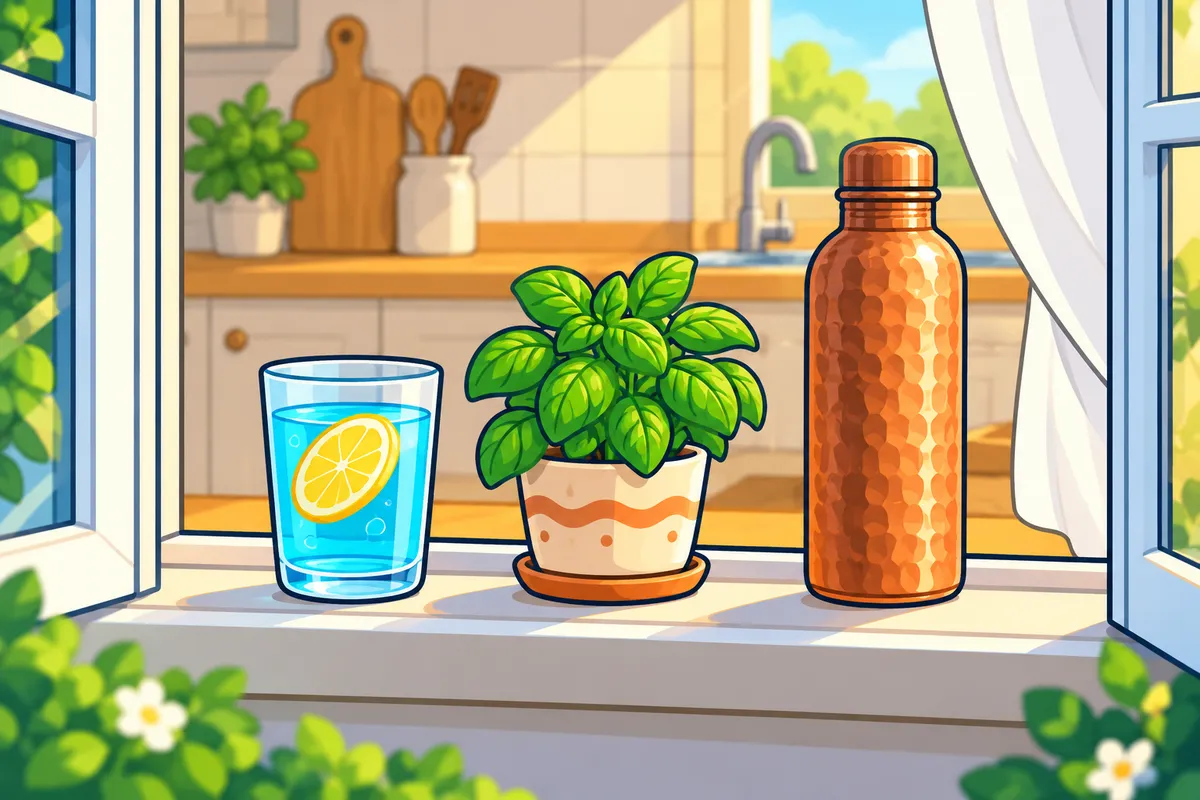
For plain water, yes: a copper bottle adds a small, measured amount of copper, well under the EPA's limit for tap water. Acidic drinks are the exception, and a few people should avoid extra copper.
Copper bottles are sold with big promises: purer water, better digestion, a habit borrowed from Ayurveda. The safety question is smaller and easier to answer. How much copper gets into the water, and is that amount a problem?
Are Copper Water Bottles Safe?
For plain water, yes. The one lab study that measured it found 0.177 mg of copper per liter after water sat in copper pots for 16 hours, about one seventh of the EPA's 1.3 mg/L action level for tap water. Acidic drinks are the exception, and a few people should avoid extra copper altogether.
The top bar is the one that matters for a bottle of plain water. The EPA sets both its health goal and its action level for copper at 1.3 mg/L, and lists gastrointestinal distress as the short-term risk and liver or kidney damage as the long-term risk above it.
Australia's guideline puts its health limit at 2 mg/L and adds a lower one, 1 mg/L, for taste and the blue-green stains copper leaves on sinks, on the NHMRC copper page.
How Much Copper Gets Into Water From a Copper Bottle?
A little, and it was measured once in a careful way. In a 2012 study, researchers kept autoclaved groundwater with a pH of 7.83 in 2-liter copper pots for 16 hours at about 26 °C. The water ended up with 177 ± 16 parts per billion of copper, which is 0.177 mg per liter.
- 16 h
- water stood in the copper pots
- 0.177 mg/L
- copper in the water afterwards
- 7.83 → 7.93
- pH before and after: almost no change
What That Means for Your Daily Water
Multiply the study's level by the liters you drink. A day of 2 liters from the bottle comes to about 0.35 mg of copper, while 2 liters of tap water right at the EPA's 1.3 mg/L level would hold 2.6 mg.
| Water a day from the bottle | Copper at study's 0.177 mg/L | Copper at the EPA's 1.3 mg/L |
|---|---|---|
| 1 liter | 0.18 mg | 1.3 mg |
| 2 liters | 0.35 mg | 2.6 mg |
| 3 liters | 0.53 mg | 3.9 mg |
Sources: Sudha et al. 2012 and the EPA; the milligrams are the study's level multiplied by the liters.
Copper is also a nutrient. MedlinePlus gives adults 900 micrograms a day as the recommended amount, so 0.35 mg from a day of bottle water would be roughly 40 % of it. That is a share of what the body needs, not an excess, but it does mean the bottle is a real source of copper and not a trace.
Why Your Bottle May Differ
The study used a pot, not a bottle, and one kind of water. A bottle with a lacquer coating, a stainless steel lining or a brand new shiny inside could release more or less. If your bottle has a lining, your water touches the lining and not the copper.
How to Tell a Lined Copper Bottle From an Unlined One
Look at the inside:
- An unlined copper bottle shows the same warm metal inside and out, and it darkens over time.
- A lined bottle has a different surface inside, stainless steel, tin or a lacquer coating, and the lining blocks contact between water and copper, so the numbers above do not apply.
If the inside stays shiny and does not tarnish, you have a lined bottle. Run your fingernail along the inner wall: a lacquer feels smooth and slippery, while bare copper has a slight drag. Some sellers label the lining; checking by eye is the reliable test when they do not.
Does a Copper Bottle Change the pH of Your Water?
Barely. In the 2012 study, the pH moved from 7.83 to 7.93 after 16 hours, a shift of 0.10 units on a scale of 0 to 14. Sellers sometimes call copper water "alkaline", but that change is too small to taste or to matter for your body, and tap water's normal range of about 6.5 to 8.5 per the EPA already covers it.
Can You Put Lemon Water in a Copper Bottle?
No. Lemon water is fruit juice in water, and the FDA Food Code, adopted into state rules such as Minnesota's, says copper and copper alloys "must not be used in contact with a food that has a pH below 6, such as vinegar, fruit juice, or wine". Acid pulls copper out of the metal and into the drink.
Your drink, and whether it goes in copper
- Plain tap or filtered water, drunk within the dayFine in copper
- Lemon water, fruit juice or a vinegar drinkA glass or a steel bottle
- Wine or anything else below pH 6Keep it out of copper
The Food Code covers restaurants and shops, where the same rule also bars copper tubing between a backflow device and a carbonator. The chemistry is the same in your kitchen, so the same rule makes sense at home.
The rule names copper alloys such as brass too, so a brass tumbler or pitcher follows the same limit. A bottle sold as copper but plated over steel is a different case: the drink touches whatever sits on the inside, and that is what to check.

What Are the Benefits of a Copper Water Bottle?
The benefit with evidence is narrow: copper can stop bacteria in contaminated water from growing. In the 2012 study, no bacteria could be grown from copper-pot water after 16 hours, while the same water in glass still held 109 to 866 colonies per ml. No study in people has tested health benefits from drinking out of copper bottles.
The study's own authors are careful about it. They seeded sterile water with six gut bacteria, including the germs that cause cholera and typhoid, at about 500 per ml, and found the bacteria could no longer be grown on a plate afterwards.
They also write that they still need to confirm whether the bacteria entered a "viable but non-culturable" state, alive but impossible to grow in the lab. That is why a copper bottle is no substitute for safe tap water or for boiling or filtering water you doubt.
| Claim you will see | What the evidence shows |
|---|---|
| "Copper purifies water" | Bacteria stopped growing in one lab test after 16 hours; not proven in the field |
| "Copper water aids digestion" | No study in people found |
| "Copper boosts immunity" | No study in people found |
| "Copper makes water alkaline" | pH rose from 7.83 to 7.93, a very small change |
Source: Sudha et al. 2012; the digestion and immunity rows rest on the absence of published trials in people.
How Long Can Water Stay in a Copper Bottle?
Up to 16 hours is what was measured, so fill it, drink it within the day and empty it at night. Overnight water drunk at breakfast, about 10 hours, falls inside the tested time. Water left for days was not measured at all, and copper keeps dissolving for as long as the water sits.

Who Should Not Drink From a Copper Bottle?
People with Wilson disease, a condition in which the body cannot get rid of copper, and anyone a doctor has told to limit copper. The NIDDK says doctors may advise people with Wilson disease to avoid copper-rich foods, and to have their water checked if it comes from a well or runs through copper pipes.
Liver or kidney disease belongs on the same ask-first list, because the EPA ties long-term copper above its limit to liver or kidney damage. The NHMRC adds that infants are thought to be most susceptible to copper's effects, so a copper bottle is no place for an infant's water.
Copper Pipes Add Copper Before the Bottle Does
If your home has copper plumbing, your tap water may already carry copper before it reaches the bottle. The NHMRC advises against using water that sat in copper pipes for 6 hours or more for food and drink where corrosion is a known problem, and says running the tap for 1 minute lowers the level. The NIDDK gives the same advice to flush the pipes before drinking and adds that a water filter may be needed to remove copper.
How to Clean and Use a Copper Bottle
Wash the inside with mild soap and warm water, then dry the bottle and its cap apart with the lid off. Unlined copper darkens as it oxidizes; a lemon-and-salt scrub removes that tarnish from the outside, but because acid pulls copper into water, finish with several plain-water rinses before the next fill.
If the water tastes bitter or metallic, stop using the bottle: copper becomes noticeable from about 1 mg/L, per the NHMRC. For a bottle that tastes metallic even with fresh water, the cause may be the water itself; checking your tap water tells you what is in it before the bottle does.
Fill it with plain water in the morning, take it with you, and wash it at night.
A stainless steel or glass bottle takes the lemon water, and the signs of a copper bottle gone wrong are the same as for any bottle: a smell, a film or a taste that does not rinse out.
General information for healthy adults, not medical advice. If a doctor has set your fluid amount, follow that.

More in Water Bottles

Sources
- Journal of Health, Population and Nutrition (Sudha et al.). Storing Drinking-water in Copper Pots Kills Contaminating Diarrhoeagenic Bacteria, 2012.
- US Environmental Protection Agency. National Primary Drinking Water Regulations, 2026.
- National Health and Medical Research Council (Australia). Australian Drinking Water Guidelines: Copper, 2001.
- Minnesota Rules (adopting FDA Food Code 4-101.14). 4626.0465 Copper; Use Limitation, 2019.
- National Institute of Diabetes and Digestive and Kidney Diseases. Eating, Diet, & Nutrition for Wilson Disease, 2026.
- MedlinePlus (National Library of Medicine). Copper in diet, 2025.
Sources checked by the Glubbo Editorial Team on Oct 19, 2026. General information, not medical advice. How we write and check our guides.

