How Much Caffeine Is in Matcha? Per Gram, Per Bowl and Per Latte
The caffeine in matcha counted by the gram, against coffee and brewed green tea, and how to measure your own scoop.
 By the Glubbo Editorial Team · Updated Oct 19, 2026 · 6 min read
On This Page
- How Much Caffeine Is in Matcha?
- How Much Caffeine Is in a Teaspoon of Matcha?
- Does Matcha Have More Caffeine Than Coffee?
- Does Matcha Have More Caffeine Than Green Tea?
- How Much Caffeine Is in a Matcha Latte?
- How Much Matcha Is Too Much in a Day?
- Can You Drink Matcha Before Bed?
- Weighing a Matcha Scoop on a Kitchen Scale
- Sources
Short answer
About 19 to 44 mg for every gram of powder.
- A 2020 review gives 18.9 to 44.4 mg of caffeine per gram of matcha.
- A 2 g serving holds about 38 to 89 mg; 4 g holds 76 to 178 mg.
- An 8 oz brewed coffee averages 135 mg, so a 2 g bowl has less.
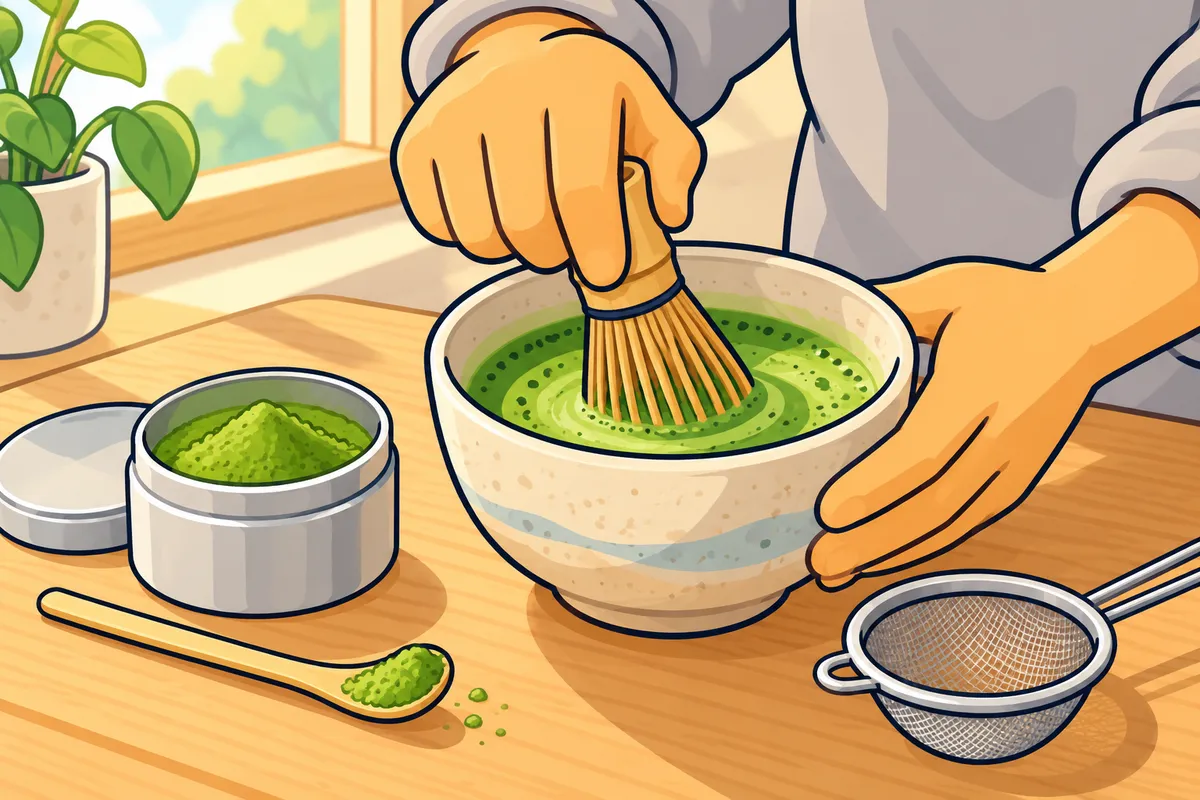
Matcha is the one tea you count by the spoon. You whisk the powdered leaf into water and drink all of it, so the caffeine in the cup is whatever the powder held.
That makes the scoop size the whole answer. A light scoop gives you less than a cup of coffee; a heavy one in a big latte can give you more.
How Much Caffeine Is in Matcha?
About 19 to 44 mg per gram of powder. A 2020 review in Molecules reports 18.9 to 44.4 mg of caffeine per gram of matcha, from a study by Koláčková and colleagues, so the total depends on how many grams you use.
The range is wide because powders differ. The same review notes that matcha comes from tea bushes shaded under bamboo mats before harvest, and powders from different growers and grades land at different points in that 18.9 to 44.4 mg spread.
Weigh your usual scoop once; it tells you more than any average.
How Much Caffeine Is in a Teaspoon of Matcha?
About 38 to 89 mg in a level teaspoon, if it holds 2 g. Tea sellers put a level teaspoon at about 2 g, with a loose one nearer 1.5 g and a packed one at 3 to 4 g, and a bamboo chashaku scoop at about 1 g, according to One with Tea and MatchaFound. Matcha is light, so the weight shifts with how tightly you pack the spoon.
| Measure | Grams | Lowest matcha in the range | Highest matcha in the range |
|---|---|---|---|
| One bamboo chashaku scoop | about 1 g | about 19 mg | about 44 mg |
| Loose level teaspoon | about 1.5 g | about 28 mg | about 67 mg |
| Level teaspoon | about 2 g | about 38 mg | about 89 mg |
| Packed teaspoon | 3 to 4 g | about 57 to 76 mg | about 133 to 178 mg |
| Level tablespoon | about 6 g | about 113 mg | about 266 mg |
The grams come from two sellers' guides, the caffeine from the 18.9 to 44.4 mg per gram in Kochman et al. 2020. A packed teaspoon can hold twice what a loose one does, which is why a scale with 0.1 g steps is more reliable than any spoon.
Does Matcha Have More Caffeine Than Coffee?
Usually not, at an everyday serving. A 2 g bowl of matcha holds about 38 to 89 mg, while Health Canada's average brewed coffee holds 135 mg per 8 oz cup. At 4 g of strong powder, matcha reaches 178 mg and passes that cup, so the grams that match your own coffee depend on the powder.
Gram for gram, matcha powder is the stronger of the two. The review cites 10.0 to 12.0 mg of caffeine per gram of coffee beans, against matcha's 18.9 to 44.4 mg. The difference flips in the cup because a cup of coffee uses many more grams of beans than a bowl of matcha uses powder.
Matcha Against Espresso
The picture is close. Hong Kong shop tests found about 97 mg in a single shot, which sits inside the range of a 3 g matcha.
Does Matcha Have More Caffeine Than Green Tea?
Yes, per cup and per gram. The FDA counts 37 mg in 12 oz of brewed green tea, less than even the lowest 2 g bowl of matcha at about 38 mg; at the top of the range a 2 g bowl holds more than twice as much.
Two things put more caffeine in a bowl of matcha than in a cup of green tea:
- The powder starts with more: the review gives 11.3 to 24.67 mg per gram for green teas against 18.9 to 44.4 mg for matcha.
- You drink the whole leaf, as the next section explains.
You Drink the Leaf, Not an Infusion
With brewed green tea, the leaves stay in the pot and only part of their caffeine reaches your cup, and steeping longer pulls out more. With matcha the whole powder goes into the water and down, so every milligram in the scoop counts, and the water's temperature or your whisking time does not change the dose; the grams do.

How Much Caffeine Is in a Matcha Latte?
As much as the matcha in it. Milk adds no caffeine, so a latte made with 2 g of powder holds the same 38 to 89 mg as a 2 g bowl, and one made with 4 g holds 76 to 178 mg, whatever the cup size.
Cafe lattes are where the count is hardest to know. Ask how many scoops go in, or use the shop's caffeine figure when it gives one.
How Much Matcha Is Too Much in a Day?
About 9 to 21 g of powder brings a healthy adult to 400 mg, the daily ceiling the FDA and EFSA agree on, depending on how strong the matcha is. EFSA treats up to 200 mg in one sitting as no concern, which is about 4.5 to 10.6 g in a single drink.
- 9–21 g
- of matcha to reach 400 mg, strongest to mildest powder
- 4.5–10.6 g
- of matcha in one drink to reach EFSA's 200 mg single dose
- 4.5 g
- of the strongest matcha to reach 200 mg, the EFSA limit in pregnancy
Few people whisk 9 g a day, so matcha alone rarely gets there. The total climbs when matcha joins coffee, tea and energy drinks on the same day, as Leo's did above.
Pregnancy lowers the line to 200 mg a day by EFSA's count, which is as little as 4.5 g of a strong powder; the pregnancy limits from each public body set out the rest.
Can You Drink Matcha Before Bed?
Not a full serving, if sleep matters to you. EFSA says single doses of 100 mg may affect sleep in some adults, especially close to bedtime, and a 3 g bowl of strong matcha holds about 133 mg. Even a 2 g bowl can hold 89 mg.
Caffeine also stays in your body for hours, so an evening bowl counts at midnight. Keep matcha to the earlier part of the day, and give your last caffeine at least six hours before you plan to sleep.
Does L-Theanine Cancel the Caffeine?
Matcha also carries L-theanine, an amino acid. The review reports up to 44.65 mg per gram in matcha powder and links its survival to the shading, but it does not cancel the caffeine in the same scoop.

Weighing a Matcha Scoop on a Kitchen Scale
A kitchen scale turns a guess into a number you can use every day.
Find the Caffeine in Your Scoop
- Put a small bowl on a kitchen scale and zero it
- Add your usual scoop of matcha and read the grams
- Multiply by 18.9 and by 44.4 for your low and high caffeine
- Count lattes by the scoops in them, not by the cup size
Which Matcha Habit Fits You
- I want less caffeine than my coffeeA level teaspoon bowl, about 2 g
- I like strong lattesWeigh the powder, and ask the shop for its scoops
- I drink tea in the eveningA caffeine-free herbal cup instead of matcha
- I am pregnantCount every gram against 200 mg a day, EFSA's line
General information for healthy adults, not medical advice. If a doctor has set your fluid amount, follow that.

More in Coffee and Tea
Sources
- Molecules (Kochman, Jakubczyk, Antoniewicz, Mruk and Janda). Health Benefits and Chemical Composition of Matcha Green Tea: A Review, 2020.
- US Food and Drug Administration. Spilling the Beans: How Much Caffeine is Too Much?, 2024.
- Health Canada. Caffeine in foods, 2025.
- European Food Safety Authority. Caffeine (topic page on the 2015 scientific opinion), 2015.
- One with Tea (tea seller). How many grams is 1 teaspoon of matcha, 2026.
- MatchaFound (matcha seller). 1 teaspoon of matcha in grams, perfect measurements, 2026.
Sources checked by the Glubbo Editorial Team on Oct 19, 2026. General information, not medical advice. How we write and check our guides.

