How Much Caffeine Is in Bubble Tea? Cup Sizes and Caffeine-Free Picks
The caffeine in a cup of bubble tea by size and tea base, which orders have none, and what one cup means for a child.
 By the Glubbo Editorial Team · Updated Oct 19, 2026 · 8 min read
On This Page
Short answer
About 130 mg in a shop cup of milk tea.
- Hong Kong tests: 100 to 160 mg a cup, 320 mg per liter on average.
- A 700 ml large cup at that strength holds about 224 mg.
- Fruit or milk drinks made without tea leaves have none.
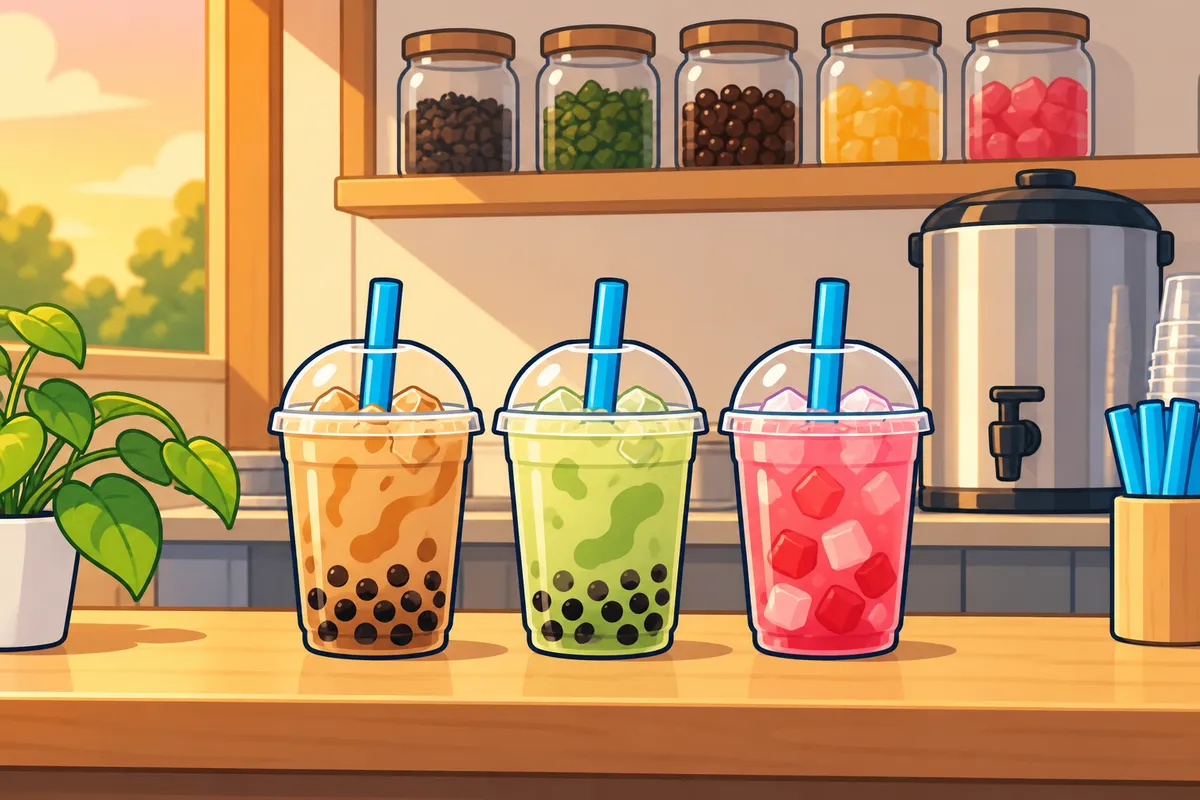
A regular cup of bubble milk tea can carry about as much caffeine as a cup of coffee, because the milk tea under the pearls is made from strong black tea. Few shops print the number.
The number in your cup depends on three things: the tea base, the cup size and whether the drink has tea in it at all. The best-known figures come from 10 cups of milk tea tested in Hong Kong in 2013, so treat them as a guide to a typical cup and not a reading of yours.
How Much Caffeine Is in Bubble Tea?
About 130 mg in a shop cup of milk tea. Hong Kong's Centre for Food Safety tested 10 cups of Taiwanese-style milk tea, the drink bubble tea shops are built on, and found 100 to 160 mg per cup, or 320 mg per liter on average. The test covered milk tea and did not name bubble tea or pearls, which add no caffeine.
Per liter, the shop milk tea was stronger than plain tea at home. The FDA's 71 mg in 12 oz of black tea works out to about 200 mg per liter, against the shops' 320 mg.
How Much Do Shops Differ From One Another?
By a factor of two in Hong Kong and far more in Taiwan. In the Hong Kong tests the weakest Taiwanese-style cup held 250 mg per liter and the strongest 490 mg. A Taiwanese study of 105 bubble teas bought from vendors across the island measured caffeine from 10.1 to 457.6, according to its abstract in the Journal of Food Protection; the abstract prints the unit as mg/mL, an apparent slip for mg per liter.
At that spread, a drink at the low end holds almost nothing and one at the high end holds as much as a strong coffee. The same order at two shops can differ by several times, which is why the shop's own figure, when it gives one, beats any average.
How Much Caffeine Is in a Large Bubble Tea?
About 220 mg in a 700 ml (24 oz) large cup at the Hong Kong average of 320 mg per liter, and up to about 340 mg at the strongest shop's strength. Cup size changes the total more than anything else you choose at the counter.
The Hong Kong study did not record cup sizes. Its 130 mg average cup implies a serving of about 400 ml, so this table runs each common size through the study's lowest, average and highest strengths.
| Cup size | Weakest shop, 250 mg/L | Average, 320 mg/L | Strongest shop, 490 mg/L |
|---|---|---|---|
| 12 oz (355 ml) | about 89 mg | about 114 mg | about 174 mg |
| 16 oz (473 ml) | about 118 mg | about 151 mg | about 232 mg |
| 500 ml regular | about 125 mg | about 160 mg | about 245 mg |
| 700 ml (24 oz) large | about 175 mg | about 224 mg | about 343 mg |
Source: worked from the per-liter results of the Centre for Food Safety, milk and ice included in the volume.
Ice takes up room in the cup, so a less-ice order gives you more tea and slightly more caffeine.
Does Bubble Tea Have More Caffeine Than Coffee?
Usually a little less than a shop coffee, and sometimes more than a home mug. In the same Hong Kong tests, the average regular coffee held 200 mg and the average Taiwanese-style milk tea 130 mg; a large milk tea at 224 mg passes the average coffee.
The coffee cups varied more: 110 to 380 mg across 20 cups, against 100 to 160 mg across the 10 milk teas. Per liter the picture flips, because shop coffee averaged 880 mg per liter, nearly three times the milk tea. The milk tea cup is simply a lot of liquid with a modest amount of tea in it.
Against home coffee the gap shrinks. Health Canada's brewed coffee averages 135 mg per 8 oz cup, about the same as a regular bubble tea, so count a cup of milk tea as you would a cup of coffee.

Which Bubble Teas Have No Caffeine?
The ones made without tea leaves or coffee. Caffeine occurs in plants such as coffee beans, tea leaves, kola nuts and cacao pods, MedlinePlus explains, so a fruit slush, a plain milk drink or a herbal base has none, while any order built on black, green or oolong tea does. Wikipedia's bubble tea entry lists black, green or oolong as the usual tea bases.
Bubble Tea Bases and Their Caffeine
Black tea milk tea
The classic, most caffeine
- 130 mg a cup in Hong Kong tests
- Plain black tea: 71 mg per 12 oz
Suits you if you want the classic and count it as a coffee
Thai tea milk tea
A strong black tea base
- Made on strong Ceylon black tea
- Shop strength not tested
Suits you if you order the orange one and count it as black tea
Green or oolong milk tea
Less in plain tea
- Plain green tea: 37 mg per 12 oz
- Shop strength not tested
Suits you if you want tea taste with less than black tea
Depends on the scoop
- Whole leaf powder, no brewing
- Can match a black milk tea
Suits you if you count matcha by the spoonful
Yuenyeung, tea with coffee
Two sources of caffeine
- Black tea, coffee and milk
- Add both sources together
Suits you if you want the strongest order on the menu
Taro, fruit or milk drink
No tea, no caffeine
- No tea leaves or coffee in it
- Fruit tea often has a tea base
Suits you if you want pearls with no caffeine at all
A "fruit tea" can be fruit syrup over green or black tea, and then it carries caffeine. Ask for the drink without the tea base, or pick one made on milk, fruit or a herbal infusion with no caffeine.
Thai tea uses strong Ceylon black tea, so count it like a black milk tea. Taro drinks go the other way: the taro has no caffeine, so ask whether the shop blends it with tea.
Do Tapioca Pearls Have Caffeine?
No. Tapioca pearls are made from cassava starch, which is not among the caffeine plants MedlinePlus lists, so all of a cup's caffeine sits in the tea. Jellies and puddings follow the same rule, unless they are coffee jelly.
Can Kids Drink Bubble Tea?
Not the tea-based kind, by Hong Kong's advice. The Consumer Council says children "are advised not to consume these types of drinks", and each of the 10 Taiwanese-style cups held more than the 95 mg daily limit the Council worked out for a 38 kg, 12-year-old child.
Health Canada sets 2.5 mg per kg of body weight a day for children and teens, and EFSA 3 mg per kg.
- 2.5 mg
- per kg a day for children and teens, Health Canada
- 3 mg
- per kg a day for children and teens, EFSA
- 130 mg
- in an average shop cup of milk tea
Pregnancy brings its own line. A large 700 ml milk tea at about 224 mg already passes the 200 mg a day that EFSA and the NHS set in pregnancy.
Can Bubble Tea Keep You Up at Night?
It can. NIOSH gives caffeine a half-life of 5 to 6 hours, so a 16 oz cup at the Hong Kong average, about 150 mg, drunk at 4 PM still leaves roughly 65 to 75 mg in you at 10 PM. A fruit or taro drink with no tea base does not.
For the evening, choose the caffeine-free base or a small size, and see how long caffeine stays in your system for the hour-by-hour curve.
How to Order Boba With Less Caffeine
You can keep the pearls and cut the caffeine with how you order.
At the Counter
5 items- Pick the small or regular size, not the large
- Choose a green tea base over black
- Ask for a milder tea base, as Hong Kong's food safety agency suggests
- Make the evening cup a caffeine-free one
- Ask the shop for its caffeine figure and write it down
The Consumer Council urged shops back in 2013 to show the caffeine in their drinks. Until yours does, count a regular cup of milk tea as about 130 mg and a large one as about 220 mg.
General information for healthy adults, not medical advice. If a doctor has set your fluid amount, follow that.

More in Coffee and Tea
Sources
- Centre for Food Safety, Hong Kong. Caffeine Content in Coffee and Milk Tea Prepared in Local Food Premises, 2013.
- Consumer Council, Hong Kong. Caffeine in coffee and milk tea (press release, 15 October 2013), 2013.
- Journal of Food Protection (Lin and colleagues), via Europe PMC. Assessment of Microbiological and Chemical Quality of Bubble Tea Beverages Vended in Taiwan, 2019.
- US Food and Drug Administration. Spilling the Beans: How Much Caffeine is Too Much?, 2024.
- Health Canada. Caffeine in foods, 2025.
- European Food Safety Authority. Caffeine (topic page on the 2015 scientific opinion), 2015.
- MedlinePlus (US National Library of Medicine). Caffeine, 2021.
- CDC, National Institute for Occupational Safety and Health. NIOSH Training for Nurses on Shift Work and Long Work Hours, Module 6: Caffeine, 2015.
- Wikipedia. Bubble tea, 2026.
- Wikipedia. Thai tea, 2026.
Sources checked by the Glubbo Editorial Team on Oct 19, 2026. General information, not medical advice. How we write and check our guides.

