Sleep and Recovery · Sleep Basics
Does Sleep Affect Weight Loss? What the Sleep Studies Found
What controlled studies found about sleep, fat loss and hunger, why the scale hides it, and how to sleep while you diet.
 By the Glubbo Editorial Team · Updated Oct 19, 2026 · 6 min read
On This Page
Short answer
Yes: short sleep makes a diet burn less fat.
- On the same diet, 5.5-hour nights cut fat loss by 55 % versus 8.5 hours.
- Two short nights lowered leptin 18 % and raised ghrelin 28 % in young men.
- Five nights of short sleep led to 0.82 kg weight gain, mostly from after-dinner eating.
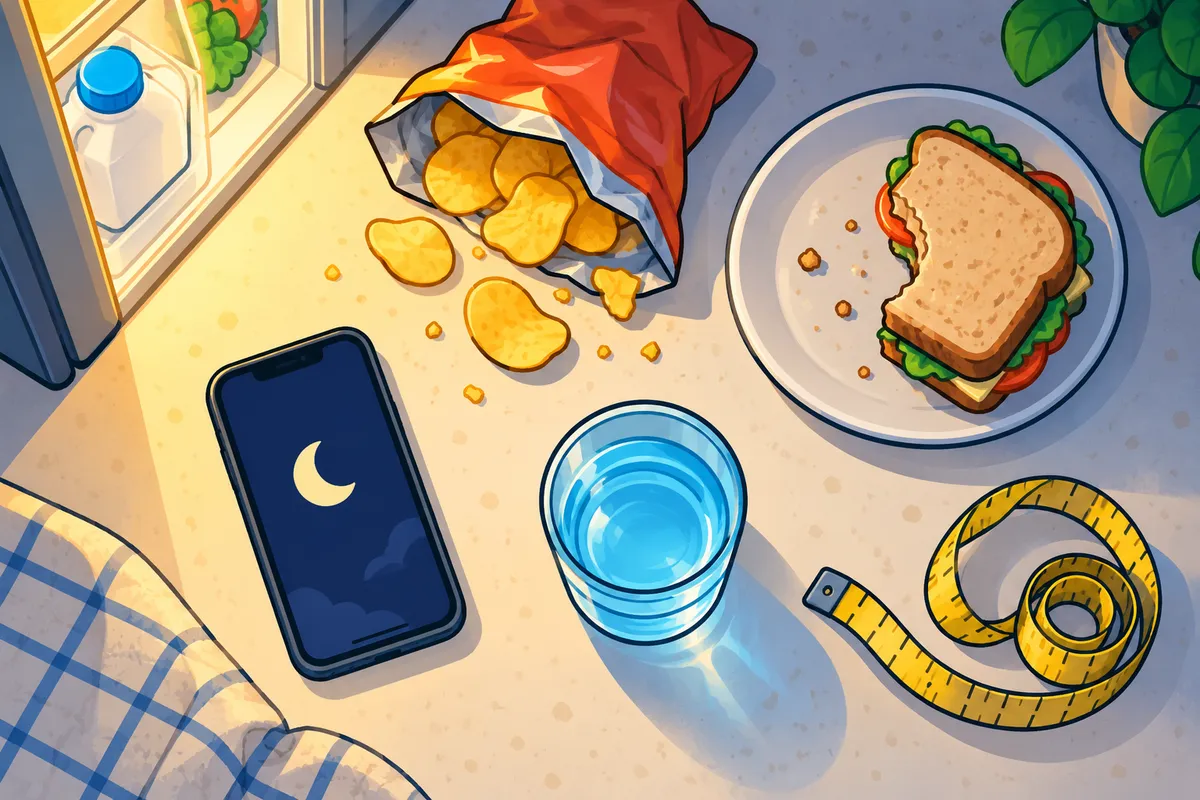
Yes: short sleep makes a diet burn less fat and makes you hungrier. In a controlled study, overweight adults on the same reduced-calorie diet lost 55 % less of their weight as fat with 5.5 hours in bed than with 8.5, and the scale hid the difference.
You count every meal, walk every day, and the scale barely moves. Meanwhile you are getting five and a half hours a night because there is no other time for anything.
Does Sleep Affect Weight Loss?
Yes, mainly in what kind of weight you lose. In a controlled study, 10 overweight adults ate the same reduced-calorie diet for 14 days, once with 8.5 hours in bed and once with 5.5. The share of weight they lost as fat fell by 55 % on short nights, and they lost 60 % more fat-free mass, which includes muscle.
8.5 Hours in Bed
- 1.4 kg of fat lost
- 1.5 kg of fat-free mass lost
- Less hunger
5.5 Hours in Bed
- 0.6 kg of fat lost
- 2.4 kg of fat-free mass lost
- More hunger
Add the two lines together and the scale tells you almost nothing: about 2.9 kg lost on long nights and 3.0 kg on short ones. On short sleep the same diet took off less fat and more of everything else.
The study was small, as its authors say themselves: 10 people over two weeks per condition. Its strength is control, because the same people did both conditions, on the same diet, in a sleep lab.
How Does Lack of Sleep Affect Weight?
Through hunger, mostly. When you do not get enough sleep, "your level of ghrelin goes up and your level of leptin goes down," the NHLBI explains; ghrelin makes you feel hungry and leptin makes you feel full, so "you feel hungrier than when you're well-rested."
Two studies put numbers on the shift, one in a lab and one in the community:
| Study | Sleep compared | Leptin (fullness) | Ghrelin (hunger) |
|---|---|---|---|
| Spiegel 2004, 12 young men, lab | 2 short nights vs 2 long nights | 18 % lower | 28 % higher |
| Taheri 2004, 1,024 adults, Wisconsin | 5 hours vs 8 hours | 15.5 % lower | 14.9 % higher |
Sources: Spiegel and colleagues, 2004, Taheri and colleagues, 2004.
The NHLBI adds the behavior that follows. Poor sleep goes with eating more, especially fatty, sweet and salty foods, and with less physical activity, and "all of these contribute to overweight and obesity," its page on why sleep matters says.
Insulin is the third route. Sleep deficiency "results in a higher-than-normal blood sugar level, which may raise your risk of diabetes," the NHLBI notes.
Does Lack of Sleep Make You Hungrier?
Yes. In the lab study, two nights of short sleep raised hunger and appetite in healthy young men along with the hormone shifts, and in the dieting study the short-sleep weeks came with more hunger on the same calories.

Does Lack of Sleep Slow Your Metabolism?
A little in one study, and not in the other. In the dieting trial, resting metabolic rate was lower after the 5.5-hour condition: 1,391 against 1,505 calories a day, a gap of 114 calories (9 people measured, at the end of each 14-day period). The authors call this drop significant and larger than the lost fat and lean mass alone would explain.
The other trial points the opposite way. Insufficient sleep raised total daily energy use by about 5 % because people were awake longer, yet they ate more than that extra burn. Whether the net effect on your waistline is positive or negative therefore depends on what you eat while you are awake.
Does Sleep Affect Weight Gain?
Yes, within a week. In a 16-person inpatient study, five nights of insufficient sleep, a working week, led to 0.82 kg of weight gain, because people ate more than the extra hours awake burned, much of it at night after dinner.
- 5 nights
- of insufficient sleep, one working week
- +5 %
- more energy burned per day while awake longer
- 0.82 kg
- average weight gained anyway
- -0.03 kg
- change after returning to enough sleep
The detail that matters is when the extra food went in. Intake ran highest "at night after dinner," the authors report, about 42 % higher on short sleep than on 9 hours in bed.
The study found differences between the sexes:
- Women stayed at steady weight on enough sleep while men did not.
- Short sleep loosened the women's dietary restraint.
The authors say the sex analyses were not planned and are exploratory, and with 8 men and 8 women the pattern is only a lead. When everyone went back to enough sleep, intake of fats and carbohydrates dropped again.
Will Sleeping More Help You Lose Weight?
It can help a diet work, but sleep alone is no weight-loss plan. When people in the inpatient study returned to enough sleep, they ate less and their weight held steady, at -0.03 kg, rather than falling.
The Wisconsin study adds a warning against overdoing it. It found a U-shaped link between sleep and body mass index:
- Below 8 hours, BMI rose as sleep fell.
- The longest sleepers did not have the lowest BMI either.
The target is enough sleep, which for most adults means the 7 or more hours the CDC sets, on a schedule you can keep.
What the Scale Hides on a Short-Sleep Diet
The dieting study's numbers make the point in two calculations, each over 14 days on the same reduced-calorie diet.
How Much Sleep Do You Need to Keep a Healthy Weight?
Seven to eight hours is the range linked with the lowest risk. NHLBI-funded research found that adults who regularly get 7 to 8 hours a night have a lower risk of obesity and high blood pressure, and the CDC's adult line is 7 hours or more.

If 6 hours has become your normal, the costs of a habit of short nights reach well beyond weight. Night workers face the same hormone pull at odd hours, plus the heart risks that years of night work carry.
A Short-Sleep Month, Planned Around Dinner
If short nights are unavoidable this month, the after-dinner window is the one to guard, because that is where the study measured the extra food. What you eat in the last hours before bed also changes how you sleep, and a full meal about 3 hours before bed leaves time to digest.
Four moves for a month of short nights
- Bedtime 30 minutes earlier before cutting more calories
- Close the kitchen after the evening meal
- On night shifts, plan 3 AM food before you leave
- Judge progress by waist and strength, not the scale alone
General information for healthy adults, not medical advice. If a doctor has set your fluid amount, follow that.

More in Sleep and Recovery



Sources
- Annals of Internal Medicine (Nedeltcheva and colleagues). Insufficient sleep undermines dietary efforts to reduce adiposity, 2010.
- Annals of Internal Medicine (Spiegel and colleagues). Sleep curtailment in healthy young men is associated with decreased leptin levels, elevated ghrelin levels, and increased hunger and appetite, 2004.
- PLOS Medicine (Taheri and colleagues). Short Sleep Duration Is Associated with Reduced Leptin, Elevated Ghrelin, and Increased Body Mass Index, 2004.
- PNAS (Markwald and colleagues). Impact of insufficient sleep on total daily energy expenditure, food intake, and weight gain, 2013.
- National Heart, Lung, and Blood Institute (NIH). How Sleep Affects Your Health, 2022.
- National Heart, Lung, and Blood Institute (NIH). Why Is Sleep Important?, 2022.
- National Heart, Lung, and Blood Institute (NIH). Sleep Apnea Symptoms, 2022.
Sources checked by the Glubbo Editorial Team on Oct 19, 2026. General information, not medical advice. How we write and check our guides.

