Sleep and Recovery · Sleeping Better
How to Stay Awake When Tired, and When Only Sleep Will Do
What lifts sleepiness for an hour or two, what does not, and the warning signs that mean you must stop driving now.
 By the Glubbo Editorial Team · Updated Oct 19, 2026 · 9 min read
On This Page
- How Do You Stay Awake When You Are Tired?
- Why Do I Feel So Sleepy in the Afternoon?
- How Do You Stay Awake While Driving?
- How Do You Stay Awake at Work?
- How Do You Stay Awake in Class?
- How Do You Stay Awake All Night?
- How Can You Stay Awake Without Caffeine?
- Getting Ready the Night Before a Long Drive
- Sources
Short answer
A short nap and a coffee work; at the wheel, stop.
- Caffeine plus a nap under 15 minutes cut driving incidents to 9 % of placebo.
- Loud radio, an open window and cold air have not proven to keep drivers awake (CDC).
- Yawning, drifting from your lane or missing an exit means get off the road now.
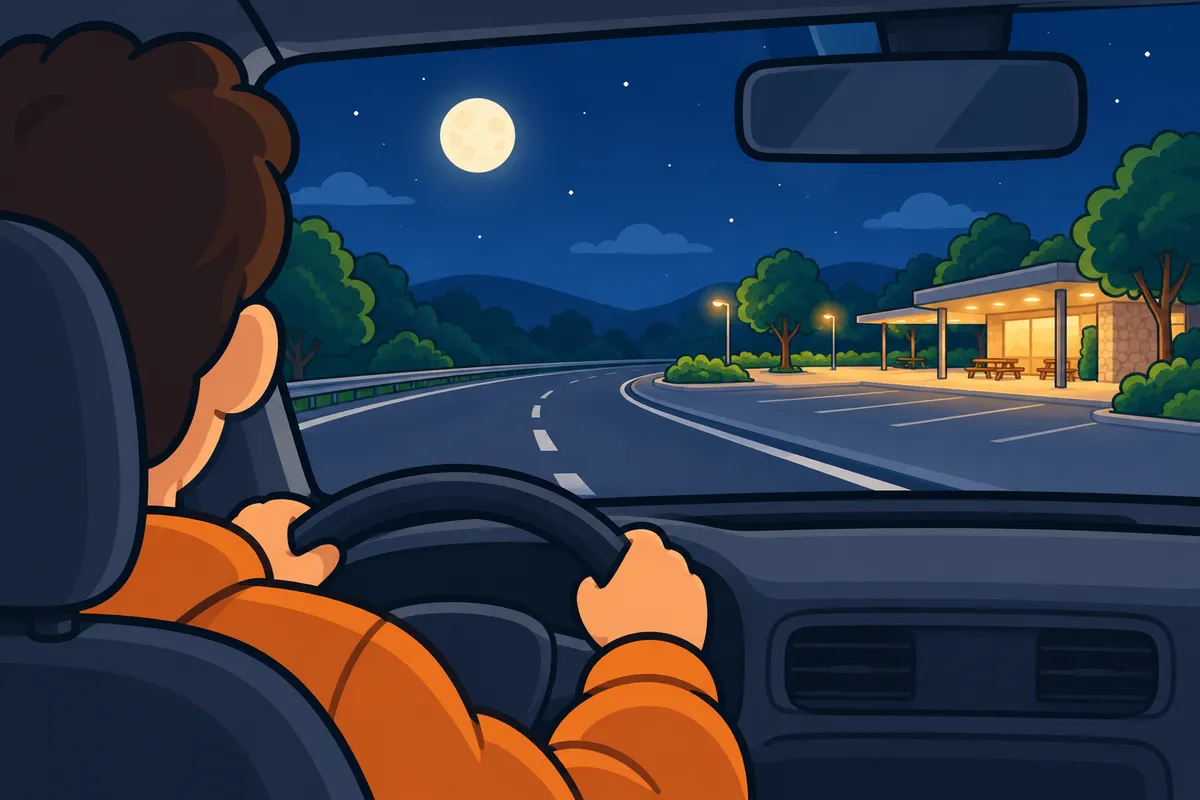
For an hour or two, take a short nap, a coffee or both; at the wheel, stop and rest. In a driving-simulator study, caffeine plus a nap of under 15 minutes cut driving incidents to 9 % of the placebo level, and tricks such as a loud radio or an open window have not proven effective, the CDC says. The drivers were 12 sleepy adults on a 2-hour afternoon drive.
It is 3 PM, the meeting has two slides to go, and your eyelids weigh more than your laptop. Or it is 11 PM on the highway with an hour left to drive.
At a desk you can buy an hour or two of alertness, with a nap, a coffee or both. Behind the wheel, the only safe move is to stop.
The two cases call for different answers.
How Do You Stay Awake When You Are Tired?
For an hour or two, take a short nap, a coffee or both: each lifts sleepiness on its own, and together they work best. Caffeine and a nap of under 15 minutes "effectively and separately reduce sleepiness in drivers for 1 hr," Reyner and Horne write. Beyond a few hours, only real sleep pays the debt back.
Buys You an Hour or Two
- A nap of 10 to 20 minutes
- A coffee, or coffee and a nap in one break
- Standing up and walking for a few minutes
- Daylight or a bright room
Does Not Work
- Loud music or an open car window (CDC)
- Cranking up the air conditioning (CDC)
- Pushing on at the wheel
- Coffee after coffee, past 400 mg a day (FDA)
Naps and caffeine have lab studies behind them; the walk and the light are cheap things to try with little measured effect, so treat them as a bridge to the next break. A 1999 review of vehicle accidents adds that cold air and the car radio are effective only for a short time.
If you feel worn out every afternoon, the fix lives at night: an earlier bedtime moves more than any trick on this page.
Why Do I Feel So Sleepy in the Afternoon?
Because two systems meet. The pressure to sleep "gets stronger every hour you are awake," the NINDS sleep page says, and your body clock adds a dip in the early afternoon that lab drivers show as a mid-afternoon peak in sleepiness.
That pressure has a chemical behind it. Cells release adenosine, which "helps make you feel sleepy," and caffeine counters sleepiness by blocking adenosine's action, NINDS explains. The adenosine is still there when the coffee wears off, which is why the slump often lands a few hours after the cup.
A short night makes the dip deeper. The NHLBI notes that nearly 40 % of adults fall asleep during the day without meaning to at least once a month, and that about 1 in 3 US adults report not getting enough rest or sleep every day.
- ~40 %
- of adults nod off in the day without meaning to, at least monthly
- 1 in 3
- US adults short of rest or sleep every day
Microsleep, the Sleep You Do Not Notice
Sleep loss can bring on microsleep, brief moments of sleep while you are normally awake. The NHLBI says you cannot control microsleep "and you might not be aware of it," which is why "I feel fine" is not a test you can trust when tired.
How Do You Stay Awake While Driving?
You do not try: you stop. The CDC advises drivers who notice the warning signs to "get off the road and rest until no longer drowsy or change drivers," and says the radio, an open window and cold air have not proven effective.
What Are the Signs You Are Too Tired to Drive?
The CDC names five warning signs. Any one of them means you leave the road at the next safe place.
Signs you are too tired to drive
5 items- frequent yawning or blinking
- difficulty remembering the past few miles driven
- missing exits
- drifting from a lane
- hitting a rumble strip
Pull into the next rest area or a safe, lit spot, lock the doors, set an alarm and nap; the 10-to-20-minute nap and how to shake off the grogginess after it work in a car seat too.
How Common Is Falling Asleep at the Wheel?
More common than most drivers think. In a CDC survey of 92,102 adults in 10 states and Puerto Rico, 4.0 % said they had fallen asleep while driving in the past 30 days.
| Group in the CDC survey | Asleep driving, past 30 days |
|---|---|
| All adults | 4.0 % |
| Ages 18 to 24 | 5.9 % |
| Ages 65 and over | 1.8 % |
| Men (age-adjusted) | 5.0 % |
| Women (age-adjusted) | 3.0 % |
| Usually sleep 5 hours or less | 9.1 % |
| Usually sleep 7 hours or more | 2.7 % |
Source: CDC MMWR, 2014, data from 2011 to 2012.
The cost shows up in crashes. The NHLBI estimates driver sleepiness is a factor in about 100,000 car accidents a year, with about 1,500 deaths, and says sleep deficiency harms driving "as much or more than being drunk." The CDC report cites estimates as high as 7,500 fatal crashes a year.
How Do You Stay Awake at Work?
Take your break as a short nap if you can, and move, step into daylight and drink water in the others. NIOSH notes that "judicious use of naps inside and outside the workplace can help increase your alertness," and asks employers to consider safe, furnished rooms for napping.
Set an alarm so the nap stays short, and tell someone, since NIOSH suggests a colleague checks on anyone who has not come back on time.
If you work nights, the sleepiness has a second cause, a body clock telling you it is 4 AM. Those hours carry longer-term health risks of their own beyond the tired shift.
Water and Food at Your Desk
A glass of water is a reason to stand up and walk, which is part of its value at 3 PM. Planned sips between meetings also stop thirst from piling onto the tiredness.
How Do You Stay Awake in Class?
Sit up front, take notes by hand and use the break to get outside. Students are among the sleepiest people around: teens need 8 to 10 hours a night, and in the CDC survey adults aged 18 to 24 had the highest rate of falling asleep while driving.
Taking notes keeps your hands and eyes busy, which makes it harder for microsleep to slip in unseen. A seat near the front puts you in the speaker's line of sight, which helps for the same reason.
The real answer for a student is a regular bedtime, and everything else on this list is a bridge to it.
How Do You Stay Awake All Night?
Plan the night like a shift: a nap beforehand, regular breaks, and a plan for sleeping afterwards. Expect the urge to sleep to keep growing through the night, because the sleep drive builds with every hour you stay awake.
The most important part comes the next morning. After a night without sleep, do not drive yourself home: take a ride, public transport or a nap first, because sleep deficiency can impair driving as much as alcohol, the NHLBI says.
Then sleep as soon as you can, in a dark room: one all-nighter costs you a day, while a habit of them builds the kind of short-sleep debt the 7-hour line warns about.
How Can You Stay Awake Without Caffeine?
Nap, move, find light and change what you are doing. None of them stays in your body to keep you awake at midnight, which a late coffee can.
Going without caffeine leaves the nap doing the work. In the simulator study, 12 sleepy drivers on a 2-hour afternoon drive had 34 % of the placebo's driving incidents after 200 mg of caffeine, and 9 % after caffeine plus a short nap; the study did not test the nap alone.
How Do You Use the Coffee Nap Break?
The study's break lasted 30 minutes, and the design is easy to copy. Park somewhere safe, drink the coffee first, nap right after, and get back to the drive when the half hour is up.
A 30-minute break with a coffee and a nap
- Park in a rest area or safe, lit spot
- Drink the coffee first
- Nap for under 15 minutes with an alarm
- Wake up with light and a face wash before you drive on
The order matters because caffeine takes about 30 minutes to reach full effect, NIOSH says, so it starts working as the nap ends. How much coffee is 200 mg? The FDA gives 113 to 247 mg for a 12-ounce cup of brewed coffee, so one regular cup lands near the study dose, and an energy drink can hold anything from 41 to 246 mg per 12 ounces.
What Does a Cold Face Wash Do?
Less than a nap. The same NIOSH course reports that bright light and washing your face helped people regain alertness faster after a nap, which makes them tools for grogginess; the water and the light do not repay lost sleep.
The Daily Ceiling for Caffeine
The FDA cites 400 mg a day, about two to three 12-ounce cups of coffee, as an amount not generally associated with negative effects for healthy adults, and notes wide variation in how sensitive people are and how fast they clear it.
The CDC asks you to avoid caffeine in the afternoon or evening, because it costs tonight's sleep and sets up tomorrow's 3 PM slump. Pushing past tiredness with more of it every day means paying for the same short night twice. That is the loop to break.
Getting Ready the Night Before a Long Drive
Most of what keeps you awake tomorrow happens tonight.
Four jobs for the evening before a long drive or shift
4 items- Count back 7 hours from your alarm and be in bed by then
- No caffeine in the afternoon or evening (CDC)
- Plan regular stops, and a passenger who can take over
- Agree to pull over at the first yawn or drift
General information for healthy adults, not medical advice. If a doctor has set your fluid amount, follow that.

More in Sleep and Recovery
Sources
- CDC, Morbidity and Mortality Weekly Report (Wheaton and colleagues). Drowsy Driving and Risk Behaviors: 10 States and Puerto Rico, 2011–2012, 2014.
- National Heart, Lung, and Blood Institute (NIH). How Sleep Affects Your Health, 2022.
- National Institute of Neurological Disorders and Stroke (NIH). Brain Basics: Understanding Sleep, 2025.
- Occupational and Environmental Medicine (Horne and Reyner). Vehicle accidents related to sleep: a review, 1999.
- Psychophysiology (Reyner and Horne). Suppression of sleepiness in drivers: combination of caffeine with a short nap, 1997.
- CDC, National Institute for Occupational Safety and Health. NIOSH Training for Nurses on Shift Work and Long Work Hours, Module 7: Naps, 2020.
- US Food and Drug Administration. Spilling the Beans: How Much Caffeine Is Too Much?, 2024.
- National Heart, Lung, and Blood Institute (NIH). What Are Sleep Deprivation and Deficiency?, 2022.
- Centers for Disease Control and Prevention. About Sleep, 2024.
- National Heart, Lung, and Blood Institute (NIH). Sleep Apnea Symptoms, 2022.
Sources checked by the Glubbo Editorial Team on Oct 19, 2026. General information, not medical advice. How we write and check our guides.

