Drinking Habits · Building the Habit
Water Challenge at Work: A 4-Week Team Plan With Points and Prizes
A ready-to-run team plan with points for your own target, a tracker to copy, team names, prizes and fair rules.
 By the Glubbo Editorial Team · Updated Nov 2, 2026 · 11 min read
On This Page
- How Do You Start a Water Challenge at Work?
- How Do You Score a Water Challenge at Work?
- A Tracker Sheet You Can Copy
- What Are Good Water Challenge Team Names?
- What Prizes Work for an Office Water Challenge?
- How Do You Keep the Challenge Fair for Everyone?
- How Long Should a Water Challenge at Work Last?
- Running It on a Warehouse Floor or a Hot Site
- The Message to Send Your Team Before Day 1
- Sources
Short answer
Score each person's own target, never liters.
- 2 points a workday for your own target, 1 more for drinking before and after lunch.
- Team score averages each player's week percent, so team size and sick days cost nothing.
- Draw prizes among everyone at 70 % or more, and keep joining opt-in.
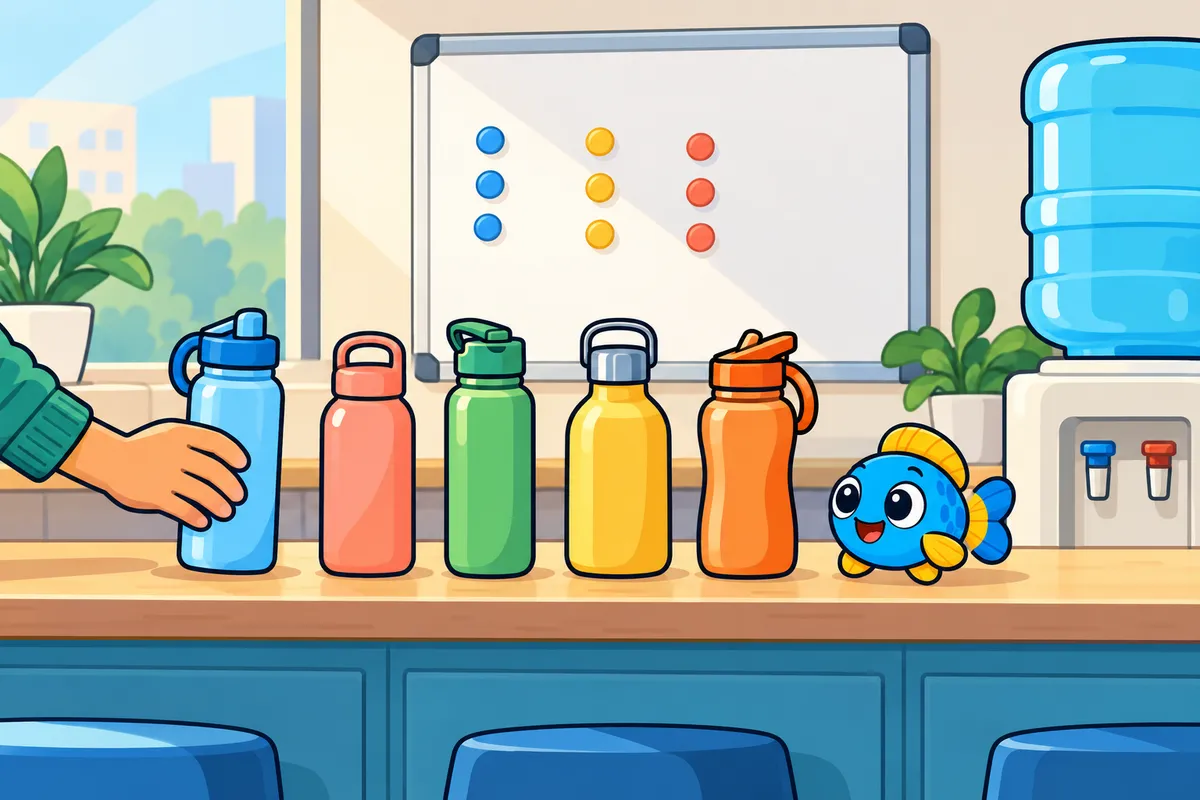
Run a water challenge at work as a team game that scores each person against their own daily target, never against the liters someone else drinks. Teams of four to six, four weeks of workdays, a shared tick sheet and a prize draw for everyone who keeps going is a format any office can start next Monday.
The rules, points, team names and sheet below are a plan to run as written or to change. The facts under it come from the sources linked in the text: the drinkable water a US workplace must have, how fast the kidneys can clear water, and the heat guidance for hot work.
How Do You Start a Water Challenge at Work?
Start in this order:
- Pick one organizer.
- Check that everyone can reach drinkable water during the day.
- Set the format: teams of four to six, four weeks, points for reaching your own target.
- Announce it two weeks ahead, and let people join or skip without giving a reason.
- Share the tracker sheet on the Friday before day 1.
Water access comes first. In the US, the OSHA sanitation standard requires potable water in every place of employment, so the challenge sits on top of a cooler or tap people can already use. If the nearest tap is two floors away, ask for a refill point near the desks before you print a single sheet.
Teams, Buddy Pairs or Everyone for Themselves
Teams suit an office of 15 or more. A team score hides any one person's bad week, and mixing departments gets people talking who rarely meet.
Buddy pairs suit a group under 10: two people check on each other at lunch and share one score. An individual leaderboard is the one format to skip, because it puts each person's day on a wall for everyone to compare.
How Do You Score a Water Challenge at Work?
Give each player these points for every workday:
- 2 points for reaching their own work-hours target.
- 1 more point for drinking both before and after lunch.
That is 3 points a day at most. Each person's week is a percent of the points they could earn on the days they worked, and the team score is the average of those percents.
| What happens on a workday | Points | Why it scores this way |
|---|---|---|
| You reach your own work-hours target | 2 | The target fits your body, so a small or seated colleague plays on equal terms |
| You drink before lunch and again after lunch | 1 | It rewards a steady day over a late catch-up |
| You drink more than your target | 0 | Extra volume earns nothing, so nobody goes past their need |
| You miss your target | 0 | A missed day never takes points away |
| Day off, sick day, travel day | Not counted | The day leaves the total, so it costs nothing |
Why Points Go to Your Own Target
A contest on liters rewards the people who already drink the most. The US National Academies reports that fluids (beverages and drinking water, not water in food) provided about 3.0 L (101 oz) a day for men aged 19 to 30 and 2.2 L (74 oz) for women of that age, from a national survey. Those are group figures: they show that people differ in what they drink, not what any one person needs.
It also rewards speed. The same report links acute water toxicity to drinking large amounts faster than the kidneys' maximal excretion rate of 0.7 to 1.0 L an hour, and NIOSH says in its guidance for work in the heat that fluid intake generally should not exceed 6 cups an hour. A rule that pays for the most water pays for the one thing that can make someone ill.
Your work-hours target is the part of your daily goal that falls between arriving and leaving; for an 8-hour day that is about half of what you drink in a day. A 68 oz (2,000 ml) daily goal gives about 34 oz (1,000 ml) at work, which is two fills of a 17 oz (500 ml) bottle.
No daily goal yet? Start from the amount an adult needs each day, and count coffee and tea: the NHS says water, lower-fat milk and lower-sugar drinks, tea and coffee included, all count toward it.
Adding Up One Team's Week
Say Benedita, who organizes the challenge, has a team of five and the first week ends like this. The flow below scores each workday; the sheet then adds points possible, points earned, and the percent.
Scoring one workday
1Is it a day off, a sick day or a travel day?
YesSkip it. The day adds nothing to points earned or points possible.
No2Did the player reach their own target and drink before and after lunch?
Yes3 points. 2 for the target and 1 for the lunch split.
No3Did the player reach their own target only?
Yes2 points. Drinking more than the target adds nothing.
No4Did the player drink before and after lunch but miss the target?
Yes1 point. The steady day still counts.
NoOtherwise0 points. A missed day never takes points away. Week % is points earned divided by 3 times the days counted, and the team score is the average of those percents.
| Player | Days worked | Points possible | Points earned | Week score |
|---|---|---|---|---|
| Player 1, full time | 5 | 15 | 15 | 100 % |
| Player 2, full time | 5 | 15 | 12 | 80 % |
| Player 3, sick on Friday | 4 | 12 | 9 | 75 % |
| Player 4, works Monday to Wednesday | 3 | 9 | 9 | 100 % |
| Player 5, full time | 5 | 15 | 6 | 40 % |
Ties, Remote Days and Late Joiners
- A tie goes to the team with more players at 100 % that week. If that is equal too, both teams take the week.
- Remote days count like office days: the player ticks their own row in the shared sheet, on trust.
- Someone who joins in week 2 starts their percent from the day they join, so a late start never drags a team down.
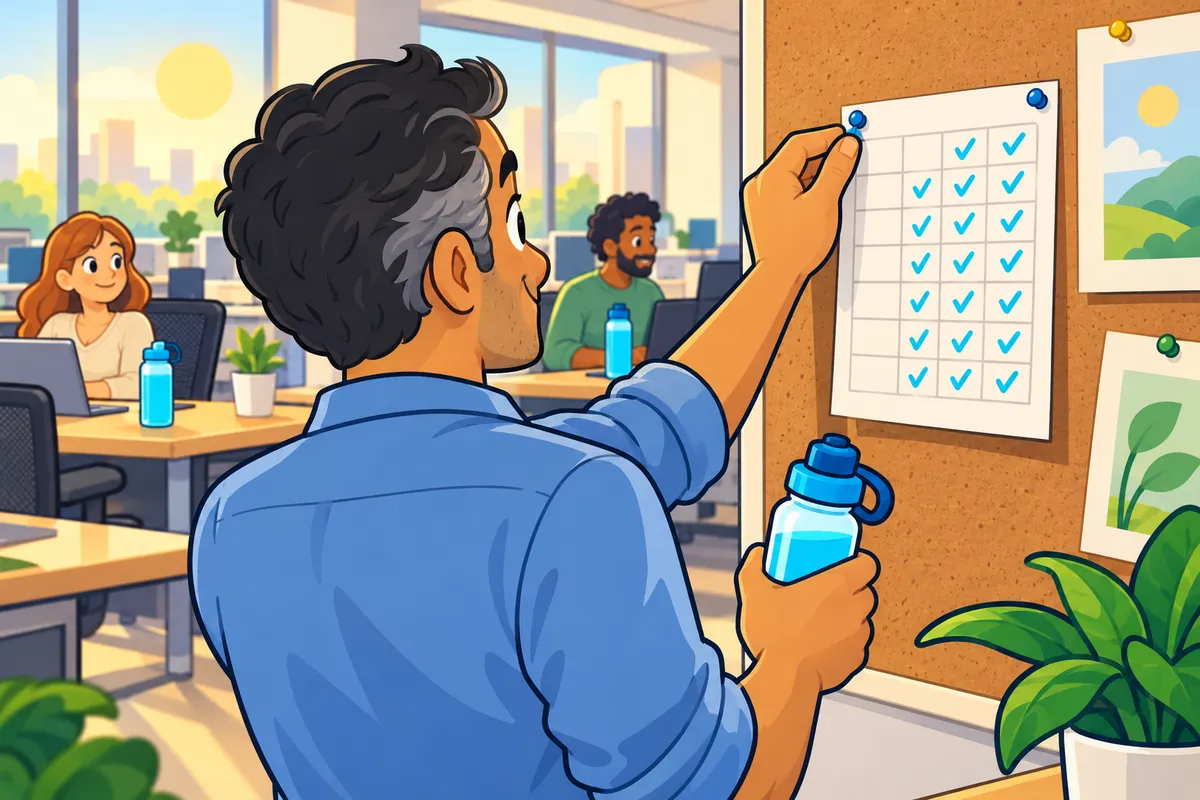
A Tracker Sheet You Can Copy
The organizer keeps this sheet off the wall; the wall gets only team percents. Use one row per player and one column per workday, with one tick per bottle fill and an S for a day the player drank both before and after lunch. Targets go on the sheet as a number of fills, never in ounces.
| Player | Fills a day | Mon | Tue | Wed | Thu | Fri | Points | Possible | Week % |
|---|---|---|---|---|---|---|---|---|---|
| Player 1 | 3 | ✓✓✓ S | ✓✓✓ S | ✓✓ S | ✓✓✓ | off | 9 | 12 | 75 % |
| Player 2 | 2 | ☐☐ | ☐☐ | ☐☐ | ☐☐ | ☐☐ | 15 |
Copy this block once for each of the four weeks. A blank row looks like Player 2: write the fills a day, leave the day cells empty, and write "off" for a day not worked. Then keep one season sheet that collects each week's percent:
| Player | Week 1 % | Week 2 % | Week 3 % | Week 4 % | Season % | In the draw |
|---|---|---|---|---|---|---|
| Player 1 | ||||||
| Player 2 | ||||||
| Player 3 | ||||||
| Player 4 | ||||||
| Player 5 |
Season %, column F: =AVERAGE(B2:E2), which skips weeks left blank by a late joiner. In the draw, column G: =IF(F2>=0.7,"yes",""). Team season score: =AVERAGE(F2:F6).
Player 1's week is Monday 3, Tuesday 3, Wednesday 1 (steady, target missed), Thursday 2 (target, no lunch split) and Friday off: 9 of 12.
In a shared spreadsheet, put each day's points (0 to 3) in the day cells and write "off" for a day not worked. Four formulas then do the sums in both Google Sheets and Excel, for a sheet whose day columns are C to G:
- Points, column H:
=SUM(C2:G2), which skips the word "off" - Possible, column I:
=3*COUNT(C2:G2), which counts only days with a number - Week %, column J:
=H2/I2, formatted as a percent - Team score, under the last player:
=AVERAGE(J2:J6)
For your own fills at the desk, print a personal sheet sized to your bottle and copy the day's ticks to the team row on Friday.
What Are Good Water Challenge Team Names?
Good team names are short enough to fit a whiteboard column, a little silly, and about water or the work your team does. Let each team vote on its own name in the kickoff chat. Leave out any name that teases one member, a department's mistakes or someone's body, since the game only works if everyone wants to be on the board.
| Kind of team | Names to pick from |
|---|---|
| Water puns | Sip Happens, Hydro Homies, H2Whoa, The Thirst Responders, Tap Dancers, Making Waves |
| Office life | Water Cooler Club, Refill Rangers, The Bottle Necks, Reply All Refills, Out of Office Oasis |
| By department | Liquid Assets (finance), Ticket Sippers (support), Pipeline Pourers (sales), Debug and Drink (engineering) |
| Shifts and sites | Midnight Refill (night shift), Dock Drinkers (warehouse), Ward Waterers (clinic) |
A name with the team's department in it makes the Friday post easy to read. A pun-only name is more fun when teams are mixed across departments.
What Prizes Work for an Office Water Challenge?
Small prizes that every steady player can win work best: a draw among all players at 70 % or more over the four weeks, plus one shared prize for the top team. Keep the value low and never tie a prize to how much anyone drinks, so nobody pushes past their target to win.
Prizes by Budget
- No budget at allThe top team picks the next team lunch spot or the office playlist for a month
- Under $10 a personA draw among finishers for a coffee voucher or an insulated mug
- $10 to $25 a personA reusable bottle for every finisher, in a size they choose
- A manager can approve timeA late start or an early finish for the top team in a quiet week
The finisher draw matters more than the top-team prize. A player with a doctor's fluid limit can reach 100 % on a small target, so the draw gives them the same chance as anyone.
How Do You Keep the Challenge Fair for Everyone?
Make joining optional, keep each target private, and post only team averages. A colleague with a medical reason to drink less plays with a target their own doctor approves, or sits out, and neither choice costs the team points or needs an explanation.
The CDC tells people whose doctor limits their fluids, or who take water pills, to ask that doctor how much to drink in hot weather. It names no workplace target, so a player in that position asks the same doctor what suits work hours and follows the answer; that target scores 2 points like any other.
Rules to Post With the Sign-Up
6 items- Joining is opt-in, and nobody is asked why they sit out
- Targets go on a private card as bottle fills, never as ounces on the wall
- A target a doctor set counts in full, however small it is
- No penalties: a missed day scores 0, never a minus
- No speed rounds or finish-your-bottle dares; NIOSH's heat guidance generally caps fluid intake at 6 cups an hour
- Anyone fasting can pause and rejoin, and the paused days leave the total
A colleague fasting for Ramadan drinks only between sunset and dawn, so a work-hours target does not fit that month. Mark those days "off", or let them plan their water around suhoor and iftar and rejoin after Eid.
How Long Should a Water Challenge at Work Last?
Four weeks of workdays suits most teams: long enough to get past a slow first week, short enough to keep the Friday post fresh. Two weeks works as a summer sprint or for a group under 10. Plan what stays after the last Friday.
Two-week sprint
- 10 workdays, 30 points at most per player
- One prize moment at the end
- Fits a heat-wave fortnight or a small team
Four-week season
- 20 workdays, 60 points at most per player
- A weekly team winner plus the finisher draw
- Room for a slow first week before scores settle
How long a new routine takes to run without reminders has its own page. After week 4, keep the refill points and the bottles on the desks and drop the scoring.
Someone who wants to keep going alone can switch to a solo month that ramps up week by week. A team that would rather have a phone keep score can use one of the apps that run a timed challenge.
Running It on a Warehouse Floor or a Hot Site
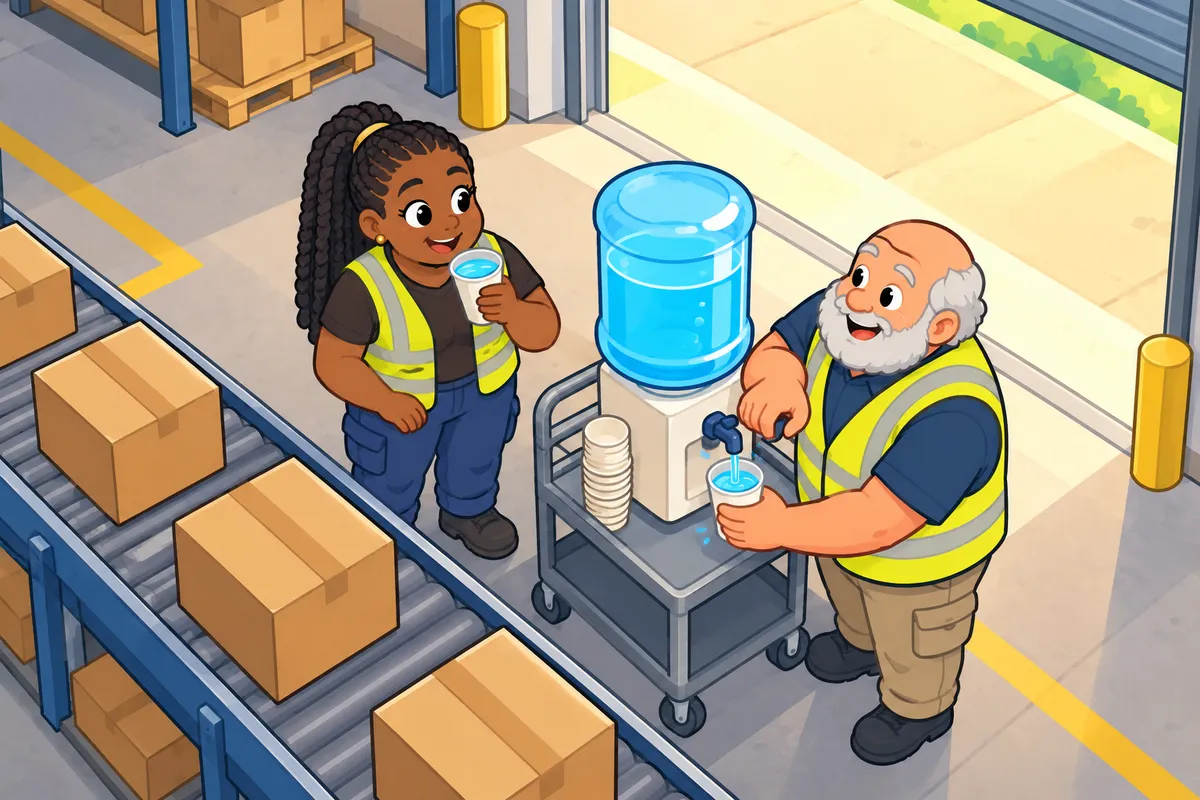
Where people work in the heat, keep the points but score refills at set breaks instead of a daily target. NIOSH advises 1 cup (8 oz) every 15 to 20 minutes for moderate work in the heat that lasts under two hours, and generally no more than 6 cups an hour.
Put the water where the work is. NIOSH asks for cool water, below 59 °F (15 °C), near the work area, and OSHA bars open barrels or pails people have to dip into.
The Message to Send Your Team Before Day 1
Send one short message two weeks ahead, with the rules in it, so nobody has to ask. Copy it, then add your start date and the prize.
Then, every Friday of the challenge:
- Collect the week's rows by 3 PM.
- Work out each player's percent and each team's average.
- Post the team percents and the week's winner, never single scores.
- Clear the day columns for Monday and keep the fills column.
General information for healthy adults, not medical advice. If a doctor has set your fluid amount, follow that.

More in Drinking Habits

Sources
- US Department of Labor, OSHA. 29 CFR 1910.141, Sanitation, 2026.
- National Academies of Sciences. Dietary Reference Intakes for Water, Potassium, Sodium, Chloride, and Sulfate: Summary, 2005.
- CDC NIOSH. Workplace Recommendations, 2026.
- CDC. Heat and Older Adults (Aged 65+), 2024.
- NHS. Water, drinks and hydration, 2023.
Sources checked by the Glubbo Editorial Team on Nov 2, 2026. General information, not medical advice. How we write and check our guides.

